







Mosquito control in Karachi is not a single problem. We deal with three vectors that breed in different places, bite at different times, and carry different diseases — and an intervention that works against one is wrong for another. Aedes aegypti, the dengue mosquito, breeds in clean container water and bites in daylight. Anopheles stephensi, the Karachi malaria vector, breeds in overhead tanks and construction puddles and bites indoors at night. Culex quinquefasciatus, the nuisance night-biter, breeds in polluted drain water and is the mosquito at your ear at 2 a.m. We are Nest Fumigation Services Private Limited, run by Saad Danish from a DHA Phase 4 office. This page sets out our protocol — chemistry, seasonal calendar, residential and society programmes, and pricing bands. Source reduction is the only intervention that lowers transmission long-term, and that fact shapes every recommendation below.
Mosquito spray, fogging or fumigation — what people mean when they call
Almost nobody rings us asking for “mosquito control”. They ask for mosquito spray, or a mosquito fumigation service, or they want us to “do fogging”. In Karachi the three get used interchangeably, and it is worth separating them, because they are different jobs and only one of them is usually what a home needs.
Mosquito spray in normal usage means a residual application — Permethrin 10% EC or similar put onto the surfaces mosquitoes rest on: shaded walls, under-stair returns, the underside of foliage, the damp corners of a compound. It keeps working for weeks after application, because a mosquito spends most of its life resting rather than flying. This is the part that produces a lasting difference and the part most operators skip.
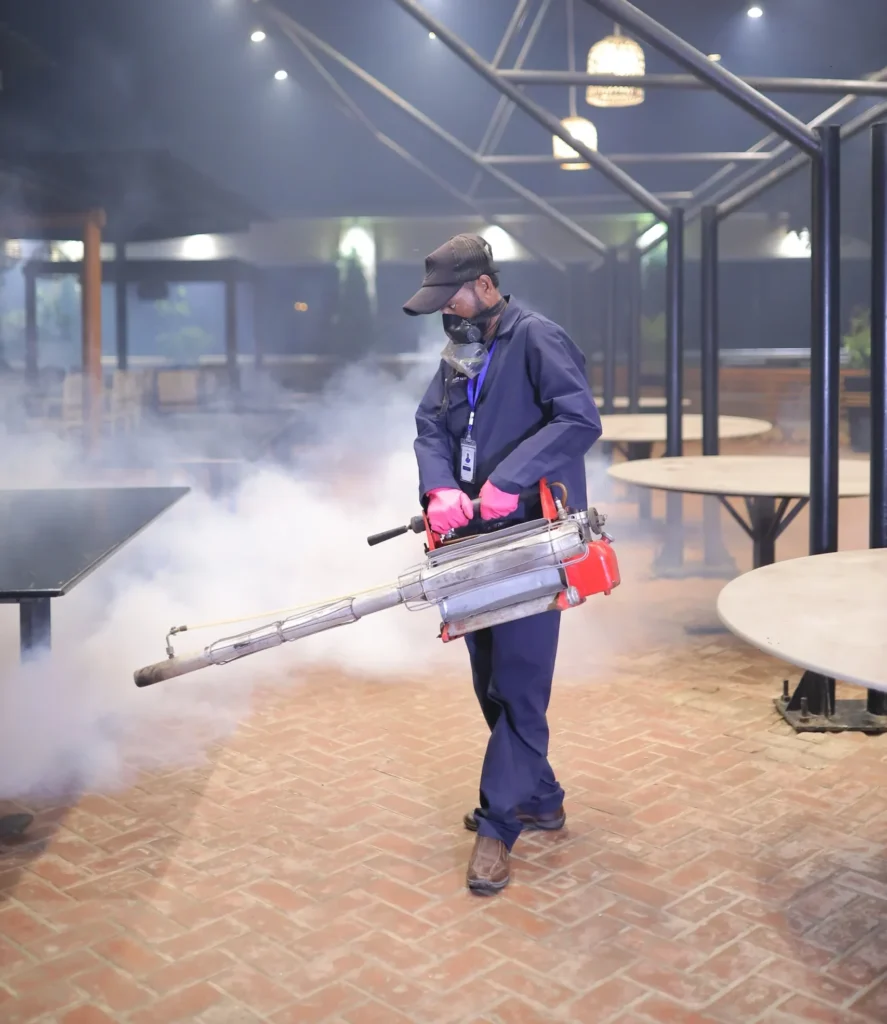
Mosquito fogging is the visible one — the ULV or thermal fog people associate with dengue campaigns. It contacts adults that are airborne at that moment and leaves no meaningful residue. It is genuinely useful for an outbreak, an event, or a society-wide knockdown, and close to useless as a standalone routine.
| What you’re comparing | NFS | Most Karachi providers |
|---|---|---|
| Active ingredients named | Deltamethrin ULV fogging + Bti larvicide for Aedes aegypti / Anopheles / Culex | "WHO approved" / "eco-friendly" hand-wave — no active ingredients named |
| Pricing published | PKR ranges per tier — published on every service page | "Free survey" — no rates disclosed before site visit |
| Warranty terms | Written warranty per service — termite up to 10 yr structural, retreat clauses spelled out | Verbal or "3-month retreat" with no written terms |
| Google reviews | 175 verified Google reviews (4.9★) on a 2-year-old profile | Text testimonials with no verifiable platform attribution |
| Certifications | ISO 9001:2015, SPMA member, KCCI member, PPMA member — numbers on bio page | "ISO certified" / "WHO approved" claimed without registration numbers |
| Response time | Same-day site inspection, scheduled treatment next business day | 2–5 business day inspection wait typical |
| Documentation | Service report after every visit — products applied, dose, lot number, technician sign-off | Verbal handover — no written application record |
Comparison verified against a June 2026 audit of seven Karachi pest-control sites: pakistanfumigation.com, ecoservices.com.pk, askfumigation.com, a1fumigations.com, karachi-fumigation.com, eliteservices.pk, karachifumigationservices.com.
Mosquito fumigation, strictly, means a sealed-enclosure gas treatment — phosphine in a tarped godown, that sort of work. Nobody fumigates a house for mosquitoes, and any company that says it does is using the word loosely. When a Karachi customer asks for a mosquito fumigation service, they almost always mean fogging plus a residual spray, which is what we quote. We would rather explain the distinction than sell you a word.
Whatever you call it when you ring, the sequence we run is the same and it is set out below: find and remove the water first, larvicide what cannot be drained, put a residual on the resting surfaces, and fog last.
Post-monsoon mosquito work pairs naturally with standing-water disinfection in courtyards and basement sumps.
The three mosquito vectors in Karachi
Aedes aegypti and Aedes albopictus — the dengue mosquitoes
Aedes aegypti is the primary urban vector for dengue (DENV-1 through DENV-4), chikungunya, and Zika. Small, dark, silvery-white lyre markings on the thorax, white-banded legs. Strict container-breeder — plant saucers, AC drip trays, blocked roof drains, decorative pots, overhead tanks with a poor lid seal. Day-biter with two peaks, 06:00–09:00 and 16:30–19:30. Flight range 100 to 200 metres, so she was almost certainly born on your plot or your neighbour's. Egg-to-adult cycle eight to twelve days at August water temperatures.
Aedes albopictus, the Asian tiger mosquito, is the secondary dengue vector — single white dorsal stripe, more tolerant of vegetation, more common in Bahria's planted streetscapes. Eggs of both species are desiccation-resistant: a container scrubbed dry and refilled is not safe.
Anopheles stephensi — the Karachi malaria vector
Anopheles stephensi is the urban malaria vector responsible for almost all locally transmitted Plasmodium vivax and P. falciparum cases in Karachi's peripheral districts. Pale brown, spotted wings, angled resting posture. Unusually for the genus, An. stephensi has adapted to urban container-breeding — overhead tanks, sump tanks, construction puddles. Indoor night-biter, peak 22:00–02:00. Karachi transmission clusters in Malir, Bin Qasim, Gadap, Korangi peripheries, and the construction belts of Bahria Town and DHA Phase 8.
Culex quinquefasciatus and Culex pipiens — the nuisance biters
Culex quinquefasciatus, the southern house mosquito, is the dominant nuisance biter — larger, pale brown, no markings. Breeds in polluted standing water (choked storm drains, septic-tank overflow, greywater pooling), bites indoors after dark, peak 21:00–03:00. The buzz at the ear in the small hours is the single most common mosquito complaint we hear. Culex pipiens appears in cooler winter months.
Vector comparison
| Vector | Disease | Breeding site | Bite time | Preferred treatment |
|---|---|---|---|---|
| Aedes aegypti | Dengue, chikungunya, Zika | Clean container water — saucers, AC trays, tanks | Day (06:00–09:00, 16:30–19:30) | Source reduction + larviciding + morning fog |
| Anopheles stephensi | Malaria (vivax, falciparum) | Overhead tanks, construction puddles | Night (22:00–02:00) | Tank larviciding + indoor residual spray |
| Culex quinquefasciatus | Filariasis, nuisance | Polluted drain water, sewage overflow | Night (21:00–03:00) | Drain larviciding + evening fog + screens |
A single "mosquito treatment" advertisement is meaningless. We need to know which mosquito is the problem before we know what chemistry to deploy.
Source reduction: the only intervention that lowers transmission
Source reduction — physically removing or emptying standing water — is the only mosquito intervention with documented long-term impact on vector population and disease transmission. Larviciding closes the containers you cannot drain. Fogging buys hours of adult knockdown. Repellents protect individuals. None of those three replaces walking the property and emptying water. WHO Integrated Vector Management and CDC dengue protocols agree on this hierarchy.
For Aedes aegypti, the highest-leverage containers are plant saucers, AC condensate drip trays, overhead tank overflow pipes without mesh, blocked roof drains, decorative fountains switched off for the rains, pet bowls, tyres in carports, and construction water on adjacent plots. For Anopheles stephensi, overhead and sump tanks dominate. For Culex, blocked storm drains and septic-tank overflow are the targets. The audit takes 45 to 90 minutes for a villa, and we usually find six to twelve breeding containers nobody had spotted. We bake the audit into every visit — without it, a fog round is theatre.
Larviciding water you can't drain
Some water cannot be drained: overhead tanks, sump tanks, decorative ponds, fire reserves. Larvicide kills mosquitoes before they emerge, and a single application holds a container clean for four to twelve weeks.
Temephos (Abate) at 1% sand granule is the WHO-prequalified larvicide for potable water and our workhorse for overhead and sump tanks. Rate: 1 ppm — one gram of 1% temephos per ten litres. Documented low mammalian toxicity. Residual in a covered tank is six to twelve weeks.
Related work we cover in Karachi:
- Dengue prevention in Nazimabad Karachi
- Pest control guides and costs
- Mosquito fogging service in Karachi — events and societies
- Fogging vs larviciding — which actually stops dengue
- Dengue spray treatment in Karachi
- Dengue fogging in Gulshan-e-Iqbal
- Mosquito control in Gulistan-e-Jauhar
- Monsoon ant control in Karachi
- Mosquito control in DHA Karachi
S-methoprene is the juvenile-hormone IGR for non-potable retention water — ornamental ponds, decorative basins. Blocks pupation rather than killing larvae. Reapply every 30 days. Pyriproxyfen is a second IGR where contamination risk to potable supply must be minimised. Bacillus thuringiensis israelensis (Bti) is the biological larvicide for fish ponds and features near play areas — specific to mosquito larvae, zero fish impact, shorter residual (7–14 days).
What we do not use: kerosene, motor oil, detergent, bleach. These contaminate water, kill fish, corrode tank linings, and deliver days of suppression at best.
Adulticide fogging: when it works and when it doesn't
Fogging kills adults in contact with the cloud during a 30 to 45 minute window. Residual on outdoor surfaces is essentially nil — under two hours in still air. By the next morning the population has rebuilt from untreated breeding sites. Routine fogging without source reduction is the most common waste of money in Karachi pest control.
Our ULV actives are deltamethrin 0.5%, a pyrethroid with rapid knockdown and low mammalian toxicity, and malathion 5% ULV, an organophosphate used in active cluster response. Both are WHO-recommended for dengue and malaria emergency vector control. Equipment is a vehicle-mounted or backpack ULV unit calibrated to a 5–25 micron droplet.
Timing differs by vector. For Aedes — a day-biter — effective fogging is 06:30–08:30 and 16:30–18:30, angled into shaded vegetation. Conventional Karachi 19:00–20:00 evening fogging was designed for Culex and misses most Aedes. For Anopheles and Culex, evening timing is correct.
Fogging makes sense in three scenarios: emergency knockdown before an outdoor function, a confirmed cluster within 200 metres, or as one component of an integrated programme. Not as a weekly standalone routine. We turn down recurring fogging-only contracts for this reason.
Karachi mosquito seasonal calendar
January to mid-March — winter low. Culex nuisance at low levels. Aedes near-absent. The right window for one-off source-reduction audits and tank-meshing repairs.
Mid-March to May — pre-monsoon build. Culex grows in drain water, early Aedes in standing water from spring showers. We start households on quarterly programmes in April.
Late June to August — monsoon ramp. First substantial rains trigger a rapid Aedes build. Construction puddles become Anopheles nurseries. Culex drain populations explode. Highest density of the year. Larviciding moves from quarterly to monthly.
Late August to mid-October — dengue peak. The case curve lags the Aedes peak by two to three weeks. Sindh Health Department reporting climbs steeply through this window year after year. Personal protection becomes the headline household intervention; larviciding and targeted fogging continue.
Late October to December — post-monsoon tail. First cool November nights break the Aedes curve. Culex persists. Source-reduction audits resume for next season.
Retainer cadence: quarterly January–May, monthly June–October, closing November visit. Societies get weekly perimeter walks through August and September.
Residential vs commercial vs society mosquito control
Independent villas and houses
A villa visit runs two to three hours: written breeding-site audit, larvicide to every tank and retention container, residual spray on bedroom walls and vegetation resting sites, optional outdoor fog at the Aedes timing window. One-page report and six-week refresh. We work across DHA Phases 1–8, Clifton, Bahria, Gulshan-e-Iqbal, Gulistan-e-Jauhar, PECHS, Bahadurabad, North Nazimabad, and Malir.
Apartment buildings and societies
Societies need a multi-week programme. Week one is a building-wide breeding-site audit covering rooftop tanks, sump tanks, lift-shaft drips, basement puddles, courtyard pots, water features, and the boundary perimeter. Week two is larvicide with a refresh schedule. Weeks three through ten are weekly perimeter walks with one mid-programme fog round if adult density warrants. The breeding-site map is the deliverable that matters — most society-level dengue failures we have audited had no map, just a fog contract.
Commercial — schools, hospitals, restaurants, hotels
Schools get a pre-term mid-August cycle and a mid-term mid-October cycle aligned to the case curve. Hospitals need low-odour indoor residual spray on zero-disruption scheduling. Hotels need a poolside Aedes protocol plus indoor Culex knockdown. For the broader service set, see our pest control services hub, the general fumigation page, or the IPM services protocol.
Personal protection: DEET vs picaridin vs IR3535
Three actives are evidence-supported for Aedes and Anopheles — DEET, picaridin, IR3535 — in that order of preference.
DEET at 20–30% is the global gold standard. Twenty percent gives 4–5 hours; 30% gives 6–7 hours. The American Academy of Pediatrics endorses DEET up to 30% on children over two months, applied once daily. Do not apply to small children's hands, and do not apply under clothing. DEET degrades plastics — keep it off watch faces and phone screens.
Picaridin at 20% gives protection comparable to 20–25% DEET. Odourless, does not damage plastics, safe over six months. Less consistently stocked locally.
IR3535 at 20% gives 3–4 hours, the gentlest on skin, appropriate for sensitive-skin family members.
What does not work as advertised: citronella candles, unstandardised eucalyptus oil, vitamin B1, ultrasonic wristbands. The one credible plant-based option is lemon eucalyptus oil standardised to 30% PMD (4–6 hours), but PMD-standardised products are hard to source in Karachi. For sleeping infants, use a permethrin-treated bed net instead of topical repellent.
Pricing for mosquito control in Karachi
Pricing varies with plot size, vector mix, and package. The bands below cover typical DHA, Clifton, Bahria, Gulshan, and PECHS bookings. We quote precisely on visit.
| Package | Typical scope | Approximate price (PKR) |
|---|---|---|
| Single villa visit | Audit, tank larviciding, perimeter residual spray, optional fog | 6,000 – 12,000 |
| Quarterly contract (4 visits/year) | Audit + larvicide + spray each visit, monsoon visit upgraded | 22,000 – 38,000 per year |
| Annual integrated retainer | Quarterly Jan–May, monthly Jun–Oct, closing Nov, priority callbacks | 45,000 – 80,000 per year |
| Society common-area programme | Building-wide audit, all-tank larvicide, weekly Aug–Sep walks, fog rounds | Quoted per unit |
Full city pricing reference: pest control prices 2026. We will not match a quote that excludes the breeding-site audit — that audit is the deliverable that determines whether the season's intervention actually works.
Book mosquito control with NFS
Same-week scheduling is normally available outside the late-August surge. From late August through October, lead time extends to one or two weeks.
Nest Fumigation Services Private Limited
Plot #14, 2/1 2nd Gizri Street, DHA Phase 4, Karachi 75500
Phone: +92-311-1101810
Email: contact@nestfumigationservices.com
Hours: Mon–Sat 09:00–21:00, Sun closed
Credentials: ISO 9001:2015, KCCI member, SPMA, PPMA
To book directly, use our contact form or WhatsApp the number above. Saad's background and operating principles are on the about page.
Frequently Asked Questions
What is the difference between Aedes, Anopheles and Culex mosquitoes?+
Aedes aegypti bites in daylight, has silvery-white lyre thorax markings and white-banded legs, and hits ankles outdoors. Anopheles stephensi and Culex quinquefasciatus bite indoors after dark; Culex is larger, plain pale brown, no banding, and is the 2 a.m. ear-buzz on exposed arms and face.
Is mosquito fogging safe for children and pets?+
Outdoor adulticide fogging with pyrethroids clears within two hours and is safe once droplets settle — keep children and pets indoors during application and 30 minutes after. For topical protection, the American Academy of Pediatrics endorses DEET up to 30% on children over two months; picaridin 20% works from six months. Under two months, use permethrin-treated nets, not topicals.
How long does mosquito fogging protection last?+
Adulticide fogging gives short-term knockdown only — populations regenerate within 72 hours from breeding containers that were not emptied. We treat it as a one- or two-round seasonal adjunct to source reduction and larviciding, justified by an outdoor function, a confirmed dengue or malaria cluster within 200 metres, or a society-level integrated programme. Weekly fogging alone is theatre.
Where do mosquitoes breed in Karachi homes?+
Aedes aegypti breeds in clean container water — roof tanks, plant saucers, AC drip trays, discarded tyres. Culex quinquefasciatus breeds in choked storm drains and septic-tank overflows. Clear the drain physically first, then dose standing water with temephos at 1 ppm or a Bti H-14 briquette every four to six weeks. Skip kerosene — it damages sewer infrastructure.
Can I prevent dengue without fumigation?+
Yes — source reduction plus topical repellent is the proven core. Empty container water weekly, screen windows, and use DEET 20–30% (4–7 hours), picaridin 20% (4–6 hours), or IR3535 against Aedes aegypti. Skip citronella candles — 30 to 60 minutes of weak, variable repellency. Lemon eucalyptus oil at 30% PMD works but is hard to source in Karachi.
Why do mosquitoes keep coming back after spraying?+
Adulticide drops to ground level within two hours; the next generation hatches in 5 to 7 days from breeding sites you did not treat — roof tanks, plant saucers, choked drains. Coils burning allethrin and transfluthrin mats give one-room knockdown, not population control. Without source reduction and Bti H-14 or temephos larviciding, Aedes and Culex numbers fully rebound.
How do I get rid of mosquitoes from my roof water tank?+
Roof tanks are the main Aedes aegypti breeding site in Karachi homes. Seal the lid with intact gauze, inspect monthly through monsoon June to September, and add Pyriproxyfen IGR or a Bti H-14 briquette to overflow trays. For Culex in adjacent overflow drains, dose temephos at 1 ppm every four to six weeks.
What chemistry do you use for mosquito fogging?+
Outdoor adulticide fogging uses Permethrin 10% EC, Deltamethrin 1.25%, or Malathion 50EC for short-term knockdown. Indoor residual on Anopheles and Culex resting walls uses wettable-powder or microencapsulated deltamethrin, lambda-cyhalothrin or alpha-cypermethrin — six to eight weeks on cement plaster. Larviciding uses Bti H-14 and Pyriproxyfen IGR. Call NFS on +92-311-1101810.
Machar spray kitni dair chalta hai?+
The residual spray on resting surfaces keeps working for roughly three to four weeks in Karachi conditions, less on surfaces washed by rain or direct sun. The fog itself lasts hours, not weeks — fog knocks down what is flying now, the residual is what holds. Yeh farq samajhna zaroori hai: if someone promises months of protection from fogging alone, they are overselling it.
Machar mar spray children aur pets ke liye safe hai?+
Yes, with normal precautions. Keep children and pets indoors during application and for 30 minutes after; outdoor pyrethroid droplets settle within about two hours. We do not spray food-contact surfaces, aquariums must be covered and their pumps switched off, and cats are more sensitive to pyrethroids than dogs, so we place accordingly.
Dengue spray aur aam machar spray mein kya farq hai?+
The chemistry overlaps, the targeting does not. Dengue work targets Aedes aegypti, a day-biting container breeder, so it is built around finding and treating standing water — roof tanks, AC drip trays, plant saucers — with fogging timed to the early-morning and late-afternoon activity peaks. General machar spray usually targets Culex, the night biter from drains and stagnant channels, and is weighted toward residual barriers. Asking for “dengue spray” and getting an evening Culex fog is a common mismatch.
Machar control ka kitna kharcha aata hai?+
Pricing is set out in the section above and depends on property size and whether you need a one-off visit or a season programme. Society and building-wide work is quoted per building rather than per flat, because treating one unit on a shared compound does not hold.
Related guides
- Best Pest Control in Karachi: How to Choose (2026 Buyer’s Guide)
- 8 Most Common Household Pests in Karachi (and How to Identify Each)
- Professional vs DIY Pest Control in Karachi: When to Do It Yourself (and When Not To)
- 9 Pest Control Mistakes Karachi Homeowners Make (and What to Do Instead)
Karachi vernacular — what customers actually say
Mosquito calls — machhar — spike in Karachi twice a year: the post-monsoon dengue window (late August through October) when Aedes aegypti breeds in basement reservoirs, and the winter Culex period when bites concentrate at dusk.
- machhar (mosquito (general))
- we treat three species: Aedes aegypti, Anopheles, Culex quinquefasciatus
- dengue machhar (dengue mosquito)
- Aedes aegypti — daytime biter; breeds in clean standing water
- fogging (ULV fogging)
- Deltamethrin 2.5% ULV is our standard adulticide outdoors
- pani jama hai (standing water)
- the breeding site we have to find before chemistry matters
- Bti (biological larvicide)
- Bacillus thuringiensis israelensis; what we drop into rooftop water tanks