A sofa is the single piece of furniture in a Karachi home that absorbs the most punishment — daily sitting, spilled chai, monsoon mud tracked in on shoes, biscuit crumbs, pet dander, and a steady fall of fine dust that drifts in through every window in this city. We have cleaned thousands of sofas across DHA, Clifton, Bahadurabad, Gulshan, North Nazimabad and the wider city, and the lesson we keep relearning is simple: sofa cleaning chemistry is not universal. A leather Chesterfield, a cotton-linen three-seater from a Tariq Road upholsterer, a velvet sectional in a Phase 8 drawing room, and a microfiber recliner from a brand showroom are four different cleaning problems with four different correct answers. On this page we explain how our team at NFS reads each fabric, picks the right method, controls drying in Karachi humidity, and prices the work fairly per seat and per fabric type.
Sofa fabric types and how each is cleaned
The first thing our technician does on arriving at your home is identify the fabric. This is not always obvious — many sofas sold in Karachi are blends, and the underside care label is often missing or has been removed during reupholstery. We carry a small toolkit of identification swabs and a portable moisture meter, and where the fabric is ambiguous we test in a hidden seam before we apply any cleaner to a visible panel.
Cotton and linen
Natural cellulose fibres are absorbent, prone to water-spotting, and shrink if over-wetted. They are common on locally upholstered sofas because the cloth is widely stocked at Tariq Road and Bohri Bazaar. We clean cotton and linen with a low-moisture encapsulation method — a neutral-pH cleaner is brushed into the fibre, it crystallises around the soil, and we vacuum out the dry residue. Where stains demand hot-water extraction we run the wand at reduced flow, follow immediately with a dry pass, and place fans to bring the moisture content back below 12% within four hours. Over-wet a linen sofa and you will see brown tide-marks at the edges of every cushion within a day — wicking from the foam below as it dries unevenly.
Velvet and chenille
Velvet and chenille have a directional pile that holds dust at the base and shows finger-marks if you brush it the wrong way. We use a soft horsehair brush and a low-moisture shampoo, work strictly along the pile direction, and finish with a pile-lifting tool that resets the nap. Steam is risky on velvet — the heat can flatten the pile permanently in patches — so we steam only where a stain demands it, and only in short bursts. Drying time is short because we use minimal water; usually two to three hours with a fan.
Microfiber
Microfiber (sometimes labelled as suede-look or alcantara-style) is a synthetic with an extremely tight weave. It resists liquid for the first thirty seconds — long enough to blot most spills before they set — but once a stain has penetrated, it locks in. Microfiber tolerates water well; we use hot-water extraction with a mildly alkaline pre-treat, scrub with a soft brush, and extract twice. The fibres dry in three to five hours and are stain-resistant again after cleaning.
Leather (full grain, top grain, bonded)
Leather is a hide, not a textile, and it must be treated with neutral-pH chemistry — anything alkaline strips the natural oils and within weeks the surface will crack. We clean leather in three steps: a damp microfibre wipe with a neutral leather soap, a rinse with distilled water, and a conditioning cream worked in with a soft cloth and buffed to a soft sheen. Bonded leather (a polyurethane skin glued onto a fabric backing — very common on lower-cost Karachi imports) needs the gentlest possible touch; it peels if you scrub it, and no cream will save a peeling bonded surface. We tell our customers honestly when their "leather" sofa is bonded and what we can and cannot do.
Faux-leather and PU
Polyurethane upholstery is treated like leather for cleaning chemistry — neutral cleaner, soft cloth — but it does not absorb conditioner, so we skip that step and apply a thin protective wax instead. PU is sensitive to direct sunlight; sofas placed near west-facing Karachi windows often crack along the seat edge after eighteen months regardless of how well they are cleaned.
Synthetic blends and unknown fabrics
Most modern Karachi sofas are polyester-cotton blends or 100% polyester. These are the most forgiving fabrics we clean — they tolerate hot-water extraction, mild alkaline pre-treats, and the full mechanical scrub. We still test in a hidden seam first. Where the fabric is genuinely unidentifiable, we default to the gentlest method: low-moisture encapsulation, neutral pH.
Fabric-method-drying comparison
| Fabric | Recommended method | Typical drying time | Typical PKR per seat |
|---|---|---|---|
| Cotton / linen | Low-moisture encapsulation | 4–6 hours | 1,500–2,500 |
| Velvet / chenille | Low-moisture shampoo, pile-lift | 2–3 hours | 2,000–3,500 |
| Microfiber | Hot-water extraction | 3–5 hours | 1,000–1,800 |
| Polyester blend | Hot-water extraction | 3–5 hours | 1,200–1,800 |
| Full / top grain leather | Wipe, rinse, condition | 30 minutes | 2,500–4,500 |
| Bonded leather / PU | Gentle wipe + protective wax | 30 minutes | 1,800–2,500 |
Our three-stage cleaning process
Every job we run follows the same three-stage sequence regardless of fabric. The chemistry and equipment change; the discipline does not.
Stage 1 — Inspection and dry vacuum
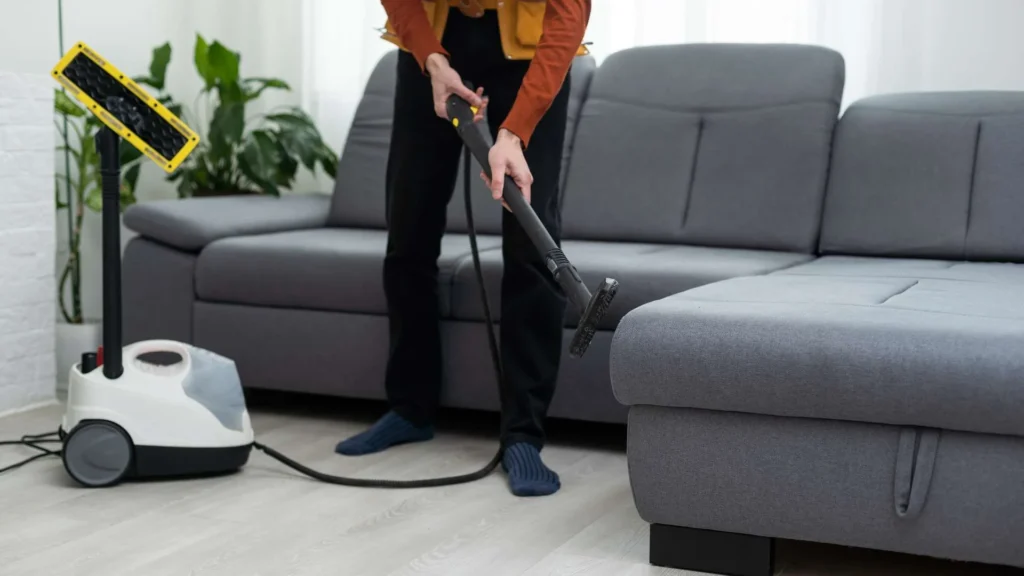
The first ten minutes are spent looking, not cleaning. We identify the fabric, check for tears or loose seams, look under cushions for stuck change and trapped debris, note pre-existing stains so they are not blamed on us later, and run a deep dry vacuum with a HEPA-filtered upholstery head. In a typical Karachi sofa we will pull 30–60 grams of fine dust out of a three-seater in this step alone — most of which is invisible until you tip the canister out. Skipping the dry vacuum is the single most common shortcut taken by cheap operators; it is also the reason their work leaves a muddy film. Once water hits unvacuumed dust, you have made paste.
Stage 2 — Pre-treat, shampoo, extract
We apply a pre-treat sized to the fabric and the soiling level, dwell for five to ten minutes, then either shampoo and extract (synthetic, microfiber, blends) or encapsulate and dry-brush (cotton, linen, velvet) or wipe-and-rinse (leather, PU). On hot-water extraction we run the machine at 70–80°C — hot enough to lift oily soil, not hot enough to set protein stains. We extract twice on every panel and check moisture with a meter before moving on.
Stage 3 — Stain treatment and final dry
Any stains that did not yield to the general pass are treated individually with stain-specific chemistry (covered in the next two sections). We then air-dry with high-velocity fans and, where the room has air conditioning, ask the customer to switch it on; AC dehumidifies the room, which dramatically speeds drying in Karachi's humid months. A final inspection with the customer present closes the job.
Chemistry: what we use and why
Cleaning is chemistry plus mechanical action plus heat plus time. Get the chemistry wrong and no amount of scrubbing will save the job.
Neutral pH for naturals and leather
Cotton, linen, silk, wool and leather are all damaged by alkalinity. Our cleaners for these fabrics sit at pH 6.5–7.5. They lift soil more slowly than aggressive alkaline products but they do not strip dye, do not raise the pile, and do not leave a residue that attracts new dirt.
Mild alkaline for synthetics
Polyester, nylon, microfiber and most synthetic blends tolerate — and clean best with — a mildly alkaline pre-treat at pH 9–10. The alkalinity emulsifies oily soil (skin oil, hair product residue, food grease) so the extraction wand can pull it out. We rinse with a neutral or slightly acidic post-spray to bring the fabric back to balance.
Enzymes for protein
Blood, urine, vomit, milk, egg, sweat — protein stains — are dissolved by enzymes that break the protein bonds. We carry a protease-based stain treatment and let it dwell for at least ten minutes before extraction. Hot water sets protein, so we always pre-treat cold.
Solvents for oil
Oil-based stains (cooking oil, butter, lipstick, ballpoint ink, makeup) need a solvent. We use a citrus-based d-limonene solvent that lifts oil without damaging most synthetic fabrics; on natural fabrics we test the solvent in a hidden seam first because some dyes are solvent-sensitive.
What we do not use
We do not use chlorine bleach on coloured upholstery, ever. We do not use ammonia on wool or silk. We do not use over-the-counter "miracle" sprays that contain optical brighteners — they leave a residue that fluoresces under sunlight and makes a clean sofa look streaky after a week. We do not use enzymatic cleaners on natural protein fibres (wool, silk) because the enzyme will attack the fibre itself.
Kid-safe and pet-safe
For homes with young children or pets we default to our plant-derived range — coconut-derived surfactants, citric acid for pH balance, no fragrance, no optical brighteners. The cleaning power is slightly lower than our standard chemistry but the safety profile is excellent. Tell the technician at booking and they will arrive equipped.
Common Karachi stains and how we handle them
Karachi sofas accumulate a specific set of stains driven by the city's climate, traffic, and food culture. These are the ones we treat most often.
Mud (monsoon and post-monsoon)
July through September, every Karachi home tracks in mud. On a sofa it usually arrives via children sitting down without changing their clothes after coming inside. Never rub a wet mud stain into the fabric — you push it into the weave. We let it dry fully, vacuum out the loose soil, then treat the remaining shadow with a neutral cleaner and gentle agitation. Most monsoon mud comes out completely if it has not been heat-set by a hot iron or a sunlit window.
Ink (ballpoint, gel, marker)
Ballpoint and gel ink are oil-based and respond to our citrus solvent. Marker ink and fountain-pen ink are water-based and respond to the alkaline pre-treat. We always identify the ink type first; using the wrong chemistry can spread the stain into a larger faint halo that is harder to remove.
Food and chai
Chai stains are tannin-based and need a slightly acidic treatment — we use a dilute citric acid solution followed by extraction. Greasy food stains (biryani oil, paratha grease) need the citrus solvent first, then a standard wash. Tomato-based curry stains can fade in sunlight but the safe answer is enzyme + solvent in combination.
Pet urine and odor
Pet urine soaks through the upholstery into the foam. Surface cleaning will lift the visible mark but the odor will return within days as the foam dries and the uric acid crystals re-activate. Real urine removal requires sub-surface injection of an enzymatic deodoriser into the cushion fill, dwell time of 30+ minutes, and extraction. We offer this as an add-on. On heavily contaminated cushions, honest counsel from us is sometimes "replace the foam" — the cost of replacement is similar to the cost of two failed deep cleans.
Dust shadows
The most common Karachi "stain" is actually accumulated atmospheric dust pressed into the fabric by sitting — a darker shadow on the seat, paler on the armrests. This is what our Stage 1 vacuum and Stage 2 shampoo together address, and it is the single biggest visible win on most jobs.
Drying time and humidity management
Karachi's coastal humidity sits at 60–80% for most of the year and over 85% during the monsoon. A wet sofa in a closed Karachi room will not dry on its own in any sensible timeframe — it will sour, grow mildew, and start to smell within 48 hours. Drying control is therefore part of the job, not an afterthought.
We bring high-velocity air movers to every hot-water extraction job. They cut drying time from 12+ hours of passive evaporation down to 4–6 hours of active drying. Where the room has air conditioning, switching it on dehumidifies the air and speeds drying further; we recommend setting the AC to 22–24°C with fan on auto for the four hours after we leave. Open windows do not help on a humid Karachi day — they let more moisture in than they let out.
You can sit on the sofa once the surface feels dry to the back of the hand, typically within 4–6 hours of our leaving. The foam underneath continues to lose moisture for another 12–18 hours; this is normal and does not affect use. If you smell anything sour two to three days after a cleaning, call us — it means moisture is still trapped in the cushion fill and we will come back and complete the drying at no charge.
Pricing by sofa size and fabric
Sofa cleaning is priced primarily by the number of seats and the fabric. Below are our standard bands. Heavily soiled sofas, pet urine treatment, and Scotchgard-style protection add to the base price; large bookings (two or more sofas, or a sofa plus carpets or mattresses) are discounted.
| Sofa configuration | Fabric band | Standard price | Heavily soiled / add-ons |
|---|---|---|---|
| 3-seater fabric | Cotton / polyester blend | PKR 4,500–6,000 | +25% |
| 3-seater fabric | Velvet / microfiber | PKR 5,500–7,500 | +25% |
| 5-seater set (3+1+1) | Cotton / polyester | PKR 7,500–10,000 | +25% |
| 5-seater set (3+1+1) | Velvet / microfiber | PKR 9,000–12,500 | +25% |
| 7-seater sectional | Any fabric | PKR 12,000–16,000 | +30% |
| Leather sofa (full / top grain) | Per seat | PKR 2,500–3,500 | Conditioning included |
| Bonded leather / PU | Per seat | PKR 1,800–2,500 | Wax included |
| Pet urine treatment (per cushion) | — | PKR 1,500–2,500 | — |
| Fabric protector (Scotchgard-style) | Per 3-seater | PKR 2,500–3,500 | — |
These bands cover most of Karachi from DHA and Clifton through Bahadurabad, Gulshan, North Nazimabad, PECHS and Bahria Town. There is no separate charge for travel within the main city. For prices on the day we will confirm after the technician sees the sofa in person — the difference between "lightly soiled" and "heavily soiled" is sometimes only obvious in the light of your own home.
Our process and what to expect on the day
We arrive in a uniformed two-person team with the extraction machine, encapsulation kit, leather kit, fans and a tarp. The tarp protects your floor; the extraction machine sits outside the room with a long hose. Total time on a 3-seater sofa is 60–90 minutes; on a full sitting-room set, 2–3 hours.
You do not need to leave the house. We will ask you to clear the immediate area around the sofa, lift any rugs that overlap the sofa skirt, and switch on the air conditioning if the room has it. After cleaning, the technician walks you through the result, points out any remaining stains that did not lift fully (we are honest about this — some stains are permanent), and confirms the price.
If you are unhappy with anything we will return and address it. This is part of our standard service; you do not pay twice.
Book sofa cleaning with NFS
To book, send us a few photos of your sofa on WhatsApp or call the office and tell us the seat count and the fabric. We will confirm a slot within the next two to three working days and give you a firm price band. Most homes book us once every six to nine months for routine maintenance; homes with young children or pets benefit from a three- to four-month cycle.
You can read more about our wider cleaning services including carpet cleaning and mattress cleaning, see the current sofa cleaning service page for a summary view, or read about our founder Saad Danish and the company's background.
Nest Fumigation Services
Plot #14, 2/1 2nd Gizri Street, DHA Phase 4, Karachi 75500
Phone: +92-311-1101810
Email: contact@nestfumigationservices.com
Hours: Mon–Sat 09:00–17:00, Sun closed
Certifications and memberships: ISO 9001:2015, KCCI, SPMA, PPMA
Contact us to book or ask a question.
Frequently Asked Questions
How much does sofa cleaning cost in Karachi?
A 3-seater fabric clean runs PKR 4,500–6,000 (cotton/polyester) or 5,500–7,500 (velvet/microfibre); full-grain leather is PKR 2,500–4,500 per seat with conditioning included. Heavy soiling adds 25%. We confirm a firm band on inspection — light vs heavy is only obvious once our SPMA-certified technician sees the sofa in your light.
What is the difference between dry cleaning and wet sofa cleaning?
Wet cleaning (hot-water extraction at 70–80°C with anionic SLS surfactant) flushes deep soil from synthetics and microfibre. Dry/low-moisture encapsulation brushes a neutral-pH crystallising polymer into cotton, linen and velvet, then vacuums the dry residue. We pick by fabric — wet on synthetics, dry on naturals — never one method for every sofa.
How long does sofa cleaning take to dry?
Hot-water extraction on synthetic or microfibre sofas is touch-dry in 3–5 hours and foam-dry in 18–24. Velvet and other low-moisture cleans dry in 2–3 hours. Leather is dry immediately. We bring high-velocity air movers to every extraction job; running your AC at 22–24°C dehumidifies the room and accelerates drying measurably.
Is sofa cleaning chemistry safe for leather?
Yes — provided pH is right. We clean leather only with neutral pH 6.5–7.5 soap, distilled-water rinse, and a conditioning cream buffed in. Alkaline cleaners strip the natural oils and crack the hide within weeks. Conditioning is included in our leather pricing because uncleaned leather in dry-AC drawing rooms cracks within a year.
Can I clean my sofa myself with home methods?
Light surface wipes are fine, but DIY usually fails on Karachi sofas. Home cleaners are unbuffered against the city's 250–350 ppm CaCO3 hard water, leaving white salt rings. Over-wetting wicks brown tide-marks up cotton and linen, and home solvents bleed dye on velvet. Professional EDTA-chelated chemistry plus moisture-controlled extraction avoids those failures.
How often should I get professional sofa cleaning?
Adult-only Karachi homes: every 9–12 months. Homes with young children: every 4–6 months. Homes with pets: every 3–4 months — dander and body oil accumulate faster than human soil. Weekly vacuuming with an upholstery attachment between cleans extends fabric life. If the seat shows a darker shadow than the back, you have waited too long.
Do you clean velvet, silk, or microfibre sofas?
Yes — each gets distinct chemistry. Velvet: low-moisture shampoo brushed along the pile, then pile-lift. Silk-blend: cool non-ionic solvent at pH ≤7.5, no enzymes (they attack the protein fibre). Microfibre: hot-water extraction with mildly alkaline pre-treat and encapsulation rinse. We test every fabric in a hidden seam before touching a visible panel.
Will sofa cleaning remove deep stains like ink or oil?
Often, yes. Ballpoint and oil stains lift with d-limonene citrus solvent; chai and tannin marks respond to an acid rinse at pH 3–4 (citric acid); blood and protein stains need a cold protease enzymatic dwell — hot water sets them. Set-in pet urine, bleach marks and sun-faded panels are permanent. We tell you honestly before starting.
Is the cleaning chemistry safe for children and pets?
Yes. Our standard range is low-residue; for infants and pets we switch to a plant-derived kit (coconut-derived surfactants, citric acid, no fragrance, no optical brighteners). We skip BAC 0.06% and 200 ppm quat sanitisation on wool and silk. Tell us at booking. Keep kids and pets out of the room during cleaning and the first hour after.
Can you bundle sofa cleaning with carpet or full-house deep cleaning?
Yes — bundles get a discount. Two or more sofas, or sofa plus carpet or mattress, is standard. NFS is ISO 9001:2015 certified and a member of SPMA, PPMA and KCCI; we run the same three-stage discipline across every service. WhatsApp seat count and fabric to +92-311-1101810 and we will quote a combined band within one working day.