







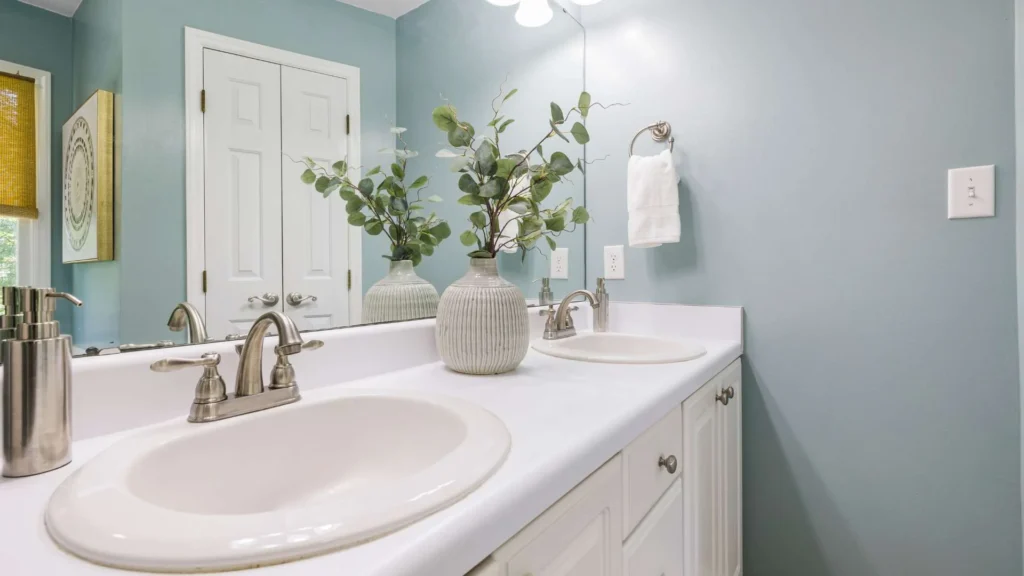
Karachi bathrooms have two problems no Western cleaning guide prepares you for. The first is our water — hard, mineral-loaded at 300-400 ppm calcium carbonate, leaving a chalky white crust on every fixture, glass screen, and tap aerator within weeks. The second is our monsoon humidity, which sits at 60-90 percent from June through September and turns every grout line, silicone seal, and ceiling corner into a mold incubator. A bathroom that was spotless on Eid morning has visible black spotting in the grout by mid-July and a limescale halo around every tap by August.
Nest Fumigation Services has been deep-cleaning Karachi bathrooms across DHA Phases 4-8, Clifton Blocks 1-9, Bahria Town, PECHS, Gulshan-e-Iqbal, and North Nazimabad for long enough to know exactly which acid descales which fixture without etching it, which grout treatments lift mold without destroying the cement matrix, and which antimicrobials actually kill the biofilm versus just smelling clean. We use phosphoric and citric descaling at pH 1-3 for hard-water deposits, hypochlorite or peroxide for mold depending on grout type, and BTC 0.13 percent quaternary ammonium for the final sanitisation pass. This page walks you through the actual protocol — chemistry, sequence, pricing, and the surface-by-surface acid-pH rules that prevent damage. From our DHA Phase 4 office, this is the job we run several times a week.
Why Karachi bathrooms are different
Three things compound here that don't compound in a Lahore or Islamabad bathroom, let alone a London one.
Water hardness. KWSB tap water hits us at roughly 300-400 ppm CaCO3 — soft water is under 60 ppm, hard water starts at 180 ppm, and we are deep into "very hard" territory year-round. Every drop of water that evaporates on your tap, shower head, glass screen, or tile leaves a mineral deposit behind. In a Clifton high-rise that draws from a borewell, mineral content runs higher. Within four to six weeks of any deep clean, you see the white halo returning. This is not your maid skipping the bathroom; this is the chemistry of the water.
Monsoon humidity. Mold growth requires only three things — a surface, organic food (soap scum and skin oils count), and moisture. From June through September, Karachi ambient humidity sits at 60-90 percent, and bathroom humidity is higher. Aspergillus, Cladosporium, and Stachybotrys spores are ambient in our air — they don't need to be introduced, only fed. Cementitious grout, silicone seals, and any unsealed wood (vanity edges) become substrate. By August every Karachi bathroom that has not been treated has visible mildew somewhere.
Coastal salt air, especially in Clifton and Defence Phase 8. The salt-laden air accelerates corrosion on chrome and brass fittings. A limescale crust that has bonded over saline-deposited iron oxide is twice the work to lift as plain mineral scale.
Joint-family use load. Many DHA and Bahria homes have 5-7 people sharing two bathrooms. Soap scum, hair, skin cell load, and biofilm accumulate fast. The "use density" of a Karachi family bathroom is well above a single-occupancy unit.
A six-month deep-clean cycle is the minimum we recommend for Karachi homes. Some clients with allergy-sensitive children or large joint families book quarterly. For the broader hygiene services we provide, see our cleaning services and cleaning services Karachi pages.
What we clean in a full bathroom deep clean
A proper bathroom deep clean is not a tile scrub. It is a complete protocol across six surface types and three contamination categories.
Tile face and floor
Glazed ceramic and porcelain tile face is the easiest surface — durable, alkali-tolerant, and acid-tolerant within reason. We use a pH 11-12 alkaline cleaner for the soap scum and body-oil film, then a separate acidic descaler at pH 2-3 for the limescale haze that makes light tile look permanently dull. Two passes, two chemistries — never mixed, because acid + alkali neutralises both into useless saltwater.
Grout — the high-skill zone
Grout is where most cleaning crews ruin a bathroom. Cementitious grout (the standard fill between tiles in 95 percent of Karachi bathrooms) is itself alkaline, with a base pH of 9-11. Strong acids — sulfuric, hydrochloric, even concentrated phosphoric — will dissolve the calcium silicate matrix and leave the grout pitted, porous, and faster to re-soil than before. This is the damage we are constantly called to assess and the original cleaner who did the damage cannot reverse it.
Our grout protocol:
- Soap scum and body oils — pH 10-11 alkaline cleaner with surfactant, dwell 5 minutes, mechanical agitation with stiff nylon brush
- Mold and mildew staining — hypochlorite (sodium hypochlorite 0.5-1 percent, freshly diluted from 5.25 percent bleach) for unsealed grout that can tolerate the oxidation, OR hydrogen peroxide 3 percent for sealed and pigmented grout where bleach would lighten the colour
- Light limescale haze on grout — citric acid 5 percent maximum, dwell 60 seconds maximum, immediate rinse. Phosphoric and HCl are off-limits on cement grout
- Deep biofilm — high-pressure steam at 4-6 bar, 100°C, which physically lifts the biofilm matrix without chemical attack on the grout
After cleaning, we recommend a penetrating silicone or fluoropolymer grout sealer applied within 24 hours. Sealed grout takes 4-6 months longer to re-soil than unsealed.
Glass shower screens
This is where Karachi water shows worst. The mineral-and-soap-scum hybrid film on shower glass is the single most-complained-about surface in any Karachi bathroom. The film is calcium carbonate scale, magnesium hydroxide, and soap-derived fatty acid salts, layered alternately.
We use a two-step on glass — first a pH 11 alkaline foam to lift the soap-scum fraction, full rinse, then phosphoric acid 5-8 percent OR citric acid 10 percent (depending on the chrome frame composition; phosphoric is faster but stains lower-grade chrome) to dissolve the mineral fraction. Razor scraper for the worst of it on tempered glass, microfibre and water-magnet squeegee for finish.
Toilet — interior, exterior, base
Bowl interior gets HCl 5-9 percent (the standard "bathroom acid" cleaner concentration) for the limescale ring at the waterline and below the rim. Glazed porcelain tolerates this. The exterior, seat, and base get the BTC 0.13 percent quaternary ammonium sanitiser — never the same brush, never the same cloth as the bowl interior (colour-coded red for toilet interior in our system). The base ring — the silicone seal between toilet and floor — gets a hypochlorite swab because this is where biofilm sits unseen.
Wash basin, vanity, and tap fittings
Ceramic basin gets the same treatment as the tile. Stone vanity tops (marble, granite, onyx — common in newer DHA and Bahria builds) are acid-sensitive — we use pH 6-8 neutral cleaner with chelator, never citric or phosphoric. Chrome and brass fittings get citric acid 10 percent for limescale and oxalic acid 5 percent for any iron staining, with immediate rinse and dry to prevent water-spot recurrence. Tap aerators come off, soak in citric for 30 minutes, refit.
Shower head, hand-held shower, hoses
Shower heads and hand-helds come off the wall and soak in citric acid 10 percent for 60-90 minutes. Karachi water clogs the spray nozzles within 6-12 months — flow drops 30-50 percent before the homeowner notices. A descaled head sprays at original pressure again. Hoses get the same soak.
Floor drain, P-trap, and silicone seals
Floor drains and bathroom drains get a hot pH 12 alkaline flush to liquefy any hair-soap-skin biofilm plug, followed by a hypochlorite chase to deodorise and sanitise. Silicone seals at the wall-floor joint, around the basin, and around the shower base get a hypochlorite swab for the inevitable mildew line. Silicone that has gone irreversibly black needs replacement — we will flag it but we do not re-seal as part of this service.
Related work we cover in Karachi:
Mirror, light fixtures, exhaust fan
Mirror gets the same alkaline-then-acid two-step as the glass screen, finished with a non-streak ammonia-free glass cleaner. Light fixtures dusted, glass shades washed, bulbs wiped. Exhaust fan vent cover comes off, fan blades degreased (yes, bathroom exhaust fans accumulate a body-oil mist film just like kitchen hoods, only thinner), refitted.
Ceiling and walls above the splash zone
Ceiling corners are where the mildew shows first in monsoon. We treat with hydrogen peroxide 3 percent applied via low-pressure mist sprayer — peroxide breaks down to water and oxygen with no residue and no surface damage. Painted walls get a damp wipe with a mild surfactant; we do not saturate gypsum board.
Surface-by-surface chemistry matrix
This is the rule book every NFS bathroom technician carries on the job card. The single biggest source of bathroom damage in Karachi is using one acid across every surface. Here is what we actually do.
| Surface | Soil | pH range | Active |
|---|---|---|---|
| Glazed ceramic tile face | Soap scum + limescale | 11 then 2-3 | Alkaline surfactant + phosphoric/citric |
| Cementitious grout | Mold + soap scum | 10-11 + oxidant | Mild alkaline + H2O2 3% or hypochlorite |
| Glass shower screen | Soap-mineral hybrid | 11 then 2 | Alkaline + phosphoric/citric |
| Toilet bowl interior | Limescale + biofilm | 1-2 | HCl 5-9% |
| Toilet exterior + seat | Microbial | Neutral | BTC 0.13% / DDAC 0.06% |
| Marble / granite vanity | Soap + body oil | 6-8 | Neutral surfactant + chelator |
| Chrome / brass fittings | Limescale | 2-3 | Citric 10% (not HCl on plated chrome) |
| Stainless steel fittings | Rust + scale | 1-3 | Oxalic 5% + citric 10% |
| Shower head | Limescale clog | 2-3 | Citric 10% soak |
| Silicone seals | Mildew | Oxidant | Hypochlorite 0.5% swab |
| Ceiling / walls (paint) | Mildew + dust | Neutral oxidant | H2O2 3% mist |
| Floor drain | Biofilm plug | 12 + oxidant | Alkaline flush + hypochlorite |
Rules our team never breaks: never mix bleach with acid (releases chlorine gas), never mix bleach with quaternary ammonium (neutralises both), never put strong acid on marble or stone, never put strong alkali on aluminium fittings, never put abrasive scouring on chrome plate.
Mold — what we can treat, what we cannot
Karachi monsoon humidity means every uncleaned bathroom has some level of mold spore presence. Our standard antimicrobial protocol handles:
- Surface mold and mildew on grout, silicone, paint, and tile — fully treatable, returns in 4-8 weeks if humidity is not controlled
- Light shadow staining in grout from cleared mold — partially reversible with peroxide or hypochlorite, full colour recovery is grout-dependent
- Mildew odour from drains, silicone, and behind toilets — eliminable with the alkaline flush + hypochlorite + BTC pass
What we cannot fix:
- Mold inside walls — black staining bleeding through paint indicates wet-wall mold; this is a plumbing-leak issue and needs the leak fixed before any treatment is permanent
- Mold embedded in deeply pitted unsealed grout — physically inside the porous matrix below the surface; partial recovery only, and re-grouting is the long-term answer
- Mold on water-damaged gypsum ceiling — the board needs replacement, not cleaning
We will assess and flag any of the above at the walkthrough so you are not paying for a treatment that will not hold.
Our 4-step bathroom deep cleaning process
Step 1 — Walkthrough and zoning (10 minutes). Supervisor identifies surface materials (acid-sensitive stone? cementitious grout? plated chrome?), checks for visible leaks or wet-wall mold, agrees the scope.
Step 2 — Pre-clean and ventilation (15 minutes). Loose hair and debris vacuumed out. Drains pre-flushed. Windows opened and an extractor fan run to vent fumes during acid work.
Step 3 — Wet work top-down (2-4 hours per bathroom). Ceiling, then walls and tile face, then glass and fittings, then vanity and basin, then toilet, then floor and drain. Each surface gets its correct chemistry, dwell time, agitation, and rinse. Acid and alkali kept on separate cloths and brushes, separated in time by full rinse cycles.
Step 4 — Sanitisation and finish (20 minutes). Final BTC/DDAC pass on all touch surfaces. Optional grout sealer applied if booked. Visual walkthrough with homeowner, taps and shower run to verify flow.
A standard single bathroom runs 2-3 hours with a 2-person crew. Master ensuites with separate shower, tub, and water closet run 3-4 hours.
Equipment we bring
- 4-6 bar steam generator — 100°C+ for grout and silicone
- Acid-resistant pump sprayers — separately labelled and colour-coded for acid vs alkaline
- HEPA wet-dry vacuum — for pre-clean debris and post-rinse water extraction
- Soft brass brushes, stiff nylon brushes — grout, silicone, drain mouths
- Razor scraper with fresh blades — for tempered glass screens only
- Water-magnet squeegees and microfibre cloth set — colour-coded by zone
- pH test strips — to confirm rinse pH before the sanitisation pass
- PPE — acid-resistant gloves, splash goggles, vapour mask for the team
Pricing range — what a Karachi bathroom deep clean costs
From our DHA Phase 4 office, 2026 pricing typically runs:
- Single small bathroom (PECHS, Gulshan apartment, 30-40 sqft) — PKR 3,500-5,500
- Standard DHA / Clifton bathroom, glass screen, granite vanity — PKR 5,500-8,500
- Master ensuite, separate shower + tub + WC, double vanity (DHA Phase 6-8, Bahria villa) — PKR 9,000-15,000
- Whole-house bathroom package (3-4 bathrooms cleaned same day) — bundled discount, typically PKR 18,000-30,000
- Grout sealing add-on — PKR 1,500-3,500 per bathroom depending on tile area
These are inclusive of chemicals, equipment, crew, and the final sanitisation. We quote firm after a WhatsApp video walkthrough.
When to schedule
Pre-monsoon (May-early June) — descale and seal grout before the humidity arrives, so mold has nothing to grab.
Mid-monsoon catch-up (mid-August) — many homes book a refresh halfway through the humid season because the mold has returned.
Pre-Ramzan — bathrooms get heavy use during sehri and taraweeh; many families want a reset before the month starts.
Pre-wedding and pre-Eid — guest-load deep clean.
Move-in / move-out — every property changeover should include a full bathroom protocol.
Service areas
We deep-clean bathrooms across:
- DHA Phases 1-8
- Clifton Blocks 1-9
- Bahria Town Karachi, all precincts
- PECHS Blocks 2, 3, 6
- Gulshan-e-Iqbal Blocks 1-13
- North Nazimabad Blocks A-T
- Bahadurabad, KDA, Federal B Area on request
Same-day service available in DHA and Clifton subject to crew slots. Other areas typically 1-2 days lead time.
What this service does not include
- Re-grouting or re-tiling — we clean what's there, we don't lay tile
- Replacing silicone seals — we clean them; if they need replacement, we flag and refer
- Plumbing repair — leak repair is a separate trade
- Pest issues — silverfish, cockroaches, and drain flies in bathrooms are pest control; see our pest control services and DHA pest control pages
- Water tank — if your bathroom water is sediment-loaded, that is upstream. See water tank cleaning
Booking
Call or WhatsApp +92-311-1101810. Send a 30-second video walkthrough showing tile, grout, glass screen, and any problem areas. Firm quote within an hour on working days.
On the day, please:
- Clear personal items from counters, vanity, and shower
- Make sure water and electricity are on (we run pumps and steam)
- Plan to keep the bathroom out of use for the working hours plus 30 minutes for surfaces to fully dry
- Let us know about any allergy or respiratory sensitivity — we can switch to lower-fume protocols
Uniformed crew, branded equipment, itemised job card, and a 7-day touch-up window on every job. Karachi bathrooms work harder than most. Treated right, every six months, they stay clean, scale-free, and mold-free year-round. Call us.