







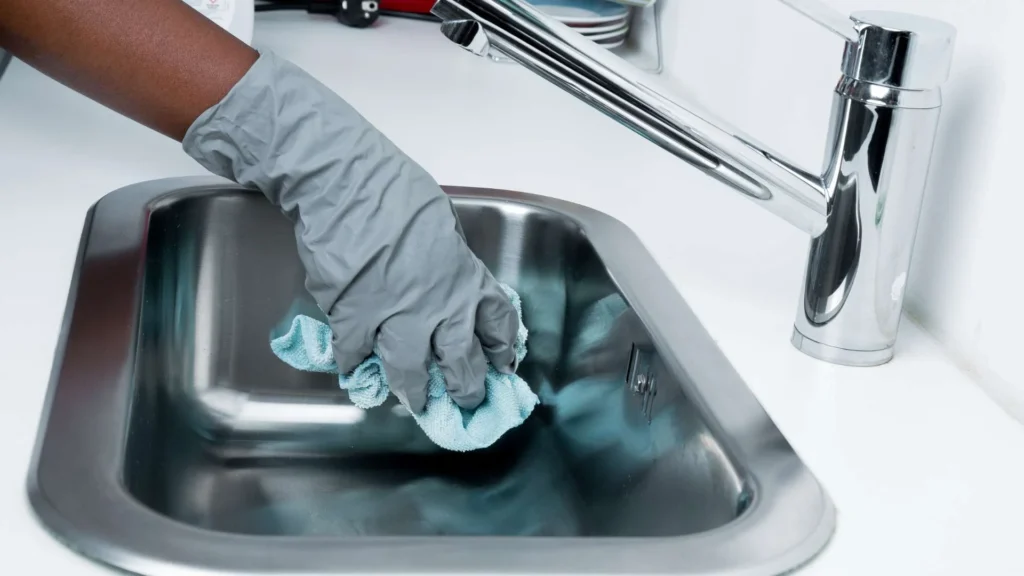
Our kitchen deep cleaning service in Karachi is a 4-6 hour visit by a 3-person crew that degreases the cooktop, burners, backsplash tile and grout, counters, cabinets inside and out, sink, drain and floor, then sanitises every food-contact surface. We work across Karachi from our DHA Phase 4 office, Monday to Saturday, and quote firm from a WhatsApp video.
A Karachi kitchen is not a Western kitchen. We cook with ghee, mustard oil, and tarka that flash-fries whole spices at smoke point. We make biryani that throws saffron-stained oil mist across the cooktop wall for forty-five minutes. We do iftar fry-ups in Ramzan, Eid bakra meat in three formats, and three dawats a month for visiting family. The grease load on a Karachi cooktop, tile, cabinet faces, and backsplash is not what a polish-and-wipe routine can handle after six months — and certainly not after a year of monsoon humidity locking that grease to every porous surface in the room.
At Nest Fumigation Services, we have done kitchen deep cleaning across DHA Phases 4-8, Clifton Blocks 1-9, Bahria Town, PECHS, Gulshan-e-Iqbal, and North Nazimabad for long enough to know exactly where the grease hides, what chemistry cracks it, and which surfaces will be ruined by the wrong cleaner. We run alkaline degreasers at pH 11-13 for tile, burner grates and the cooktop surround, high-temperature steam for polymerised deposits in grout lines, and food-contact-safe quaternary ammonium sanitisers for every surface that touches your roti, your knife, and your child's tiffin. This page walks you through what actually happens on a Karachi kitchen deep clean — the chemistry, the equipment, the sequence, and the price range — written by the team that does the job, not by a copywriter.
Why Karachi kitchens need a different cleaning protocol
The Karachi cooking style produces three grease deposit types that most general cleaners cannot tell apart, and treat with the same wrong product.
Fresh airborne oil mist settles on horizontal surfaces — the top of your fridge, the cabinet doors, the wall tile above the stove. It is still soft, still water-emulsifiable, and a mid-pH degreaser at pH 9-10 will lift it without surface damage. This is the layer a monthly maid removes.
Lipid oxidation deposits form when the airborne mist is left for three to six months. Oxygen and Karachi heat polymerise the triglycerides into a tacky, varnish-like film that is no longer water-soluble. This is what coats the backsplash tile and grout, the cabinet faces nearest the stove, and the cooktop surround. A pH-10 cleaner slides off it. You need pH 11-13 alkaline saponification — sodium hydroxide or potassium hydroxide will hydrolyse the ester bonds and convert the polymerised oil back into a water-soluble soap-salt that wipes clean.
Carbonised polymer + soot is the black, brittle, often glossy crust on burner caps, pan supports, and the back of the burner shield. This is months of grease that has crossed the smoke point and pyrolysed into a carbon matrix. No surfactant will touch it. We use solvent-based crackers plus 100-120°C pressurised steam to thermally shock the carbon shell, then mechanical extraction with non-scratch nylon and brass tools.
Add Karachi's 60-90 percent monsoon humidity and our coastal salt-laden air in Clifton, and that grease layer becomes a sticky binder that traps dust, masala powder, curry leaf debris, and atta flour particles into a single semi-permanent crust. This is why a six-month-old DHA kitchen "feels sticky" everywhere — it is not your imagination, it is the grease-dust-humidity matrix.
If the rest of the house needs the same reset, our full house deep cleaning covers every room, and washroom deep cleaning handles the other hard-water problem zone. The full menu is on our cleaning services Karachi hub.
What our kitchen deep cleaning service covers
Our standard kitchen deep clean is not a surface wipe. It is a multi-zone protocol that addresses every grease-bearing, food-contact, and water-bearing surface in the room.
Cooktop, burners, and rangetop
Burner caps and grates soak in the same alkaline tank. Gas jets are cleared with brass picks — never steel, which damages the brass orifice. Stainless steel cooktops get a separate oxalic acid 5 percent treatment for rust spotting and citric acid 10 percent for limescale around the burner rings (Karachi's hard water leaves a white halo within weeks). Glass tops get a non-abrasive pH 11 paste, never a scouring pad.
Backsplash tile, grout, and walls behind the cooktop
Tile face cleans with the same alkaline degreaser. Grout is the hard part — porous cement grout absorbs grease and turmeric (curcumin is a stubborn yellow pigment that bonds to silicates). We work the grout lines with hydrogen peroxide 3 percent under high-pressure steam, which lifts both the lipid load and the curcumin staining without etching the grout matrix. Walls above the splash zone get a vapour-mist application that breaks the grease film without saturating gypsum board behind the tile.
Counters — granite, marble, quartz, stainless steel
Granite and marble are acid-sensitive. Sulfuric, hydrochloric, and even strong citric will etch the polish and leave dull patches forever. We use pH 6-8 neutral cleaners with a chelating agent (EDTA or gluconate) to lift the embedded grease and food residue without touching the polish. Quartz tolerates slightly higher pH. Stainless steel gets oxalic acid 5 percent for rust spotting from leaving wet utensils on the surface, followed by citric acid 10 percent for limescale, then a food-grade mineral oil polish for the grain.
Cabinet exteriors, handles, and interiors
Wooden cabinet faces — especially the high-traffic ones near the cooktop — get a gentler pH 9-10 surfactant wipe that lifts the airborne grease film without lifting the polyurethane finish. Handles and pulls are sanitised separately with BTC 0.13 percent quaternary ammonium because they are the most-touched, highest-contamination surfaces in the room (raw chicken hand, then handle, then plate). Cabinet interiors are emptied, vacuumed, wiped, and a peroxyacetic acid food-contact sanitiser applied before contents are returned.
Sink, drain, and plumbing fixtures
Stainless or ceramic sink basin gets the citric acid 10 percent descaling treatment for the limescale ring (Karachi tap water is 300-400 ppm CaCO3 — a sink that hasn't been descaled in a year has 0.5-1 mm of mineral crust). Drain gets a hot pH 12 alkaline flush to liquefy the grease plug that almost always exists in the U-bend of a Karachi kitchen sink. Tap fittings and aerators are descaled with citric soak.
Floor and skirting
Floor tile gets the same pH 11-12 alkaline scrub plus hydrogen peroxide grout treatment as the backsplash. Skirting and the floor-wall joint near the cooktop hold months of grease-dust matrix — we hand-scrub these lines with a brass brush and degreaser foam.
Final sanitisation pass
Every food-contact surface — counter, sink, cabinet interior, fridge handle, microwave handle, knife block, tiffin shelf — gets a BTC 0.13 percent and DDAC 0.06 percent quaternary ammonium application. These are EPA- and PFR-listed food-contact sanitisers with measured kill of E. coli, Salmonella, and Listeria at 30-second contact time. For the cutting and prep area, we finish with peroxyacetic acid which leaves no residue and is rinse-optional.
The chemistry, surface-by-surface
Most kitchen damage we are called to repair was caused by using one cleaner across every surface. Karachi cleaning crews routinely use HCl-based "bathroom cleaner" on marble counters and ruin the polish in one application. Here is the matrix we follow, and why.
| Surface | Soil type | pH range | Active chemistry |
|---|---|---|---|
| Burner caps, grates, burner shield | Polymerised lipid + carbon | 12-13 | NaOH / KOH saponification + steam |
| Tile face (ceramic, porcelain) | Grease + masala stain | 11-12 | Sodium metasilicate alkaline |
| Tile grout (cementitious) | Grease + curcumin + biofilm | Neutral + oxidant | H2O2 3% + steam, no strong acid |
| Granite, marble | Embedded grease + food | 6-8 | Neutral surfactant + chelator |
| Quartz | Grease + light stain | 7-10 | Mild alkaline surfactant |
| Stainless steel — rust | Iron oxide | 1-2 | Oxalic acid 5% |
| Stainless steel — limescale | CaCO3 | 2-3 | Citric acid 10% |
| Glass cooktop | Burnt sugar + grease | 10-11 | Non-abrasive alkaline paste |
| Wood cabinet face | Airborne grease film | 9-10 | Mild surfactant, low-water |
| Food-contact surfaces | Microbial load | Neutral | BTC 0.13% / DDAC 0.06% / PAA |
The rule we drill into every technician on our team — never put strong acid on stone, never put strong alkali on aluminium, never put abrasive on glass cooktop, never put bleach on quaternary ammonium (they neutralise each other into useless water).
Our 4-step kitchen deep cleaning process
Step 1 — Walkthrough and zoning (15 minutes). Our supervisor arrives, walks the kitchen with the homeowner, identifies grease-load zones, notes any acid-sensitive surfaces (marble, brass fittings, aluminium handles), checks if appliances move, and agrees on what stays in place and what comes out.
Step 2 — Disassembly and soak (45 minutes). Burner caps and grates come out and go into the heated alkaline soak tank we bring on site. Cabinet contents come out where needed. Floor protection laid.
Step 3 — Wet work top-down (3-5 hours depending on kitchen size). We always work top-to-bottom — upper cabinet tops and faces, then wall tile and backsplash grout, then counter, then lower cabinets, then sink and appliances, then floor. Steam, foam, dwell time, mechanical agitation, rinse. Soaked components are scrubbed, rinsed, dried, and refitted in the order we removed them.
Related work we cover in Karachi:
Step 4 — Sanitisation and handover (30 minutes). Every food-contact surface gets the BTC/DDAC sanitiser. Final visual walkthrough with the homeowner. We light the burners, run the tap, and confirm flame, flow, and finish before we leave.
A full 1-cook-zone kitchen deep clean runs 4-6 hours with a 3-person crew. Open-plan kitchens with an island or double oven run 6-8 hours.
What we use — equipment list
We do not show up with a bucket and rags. A Karachi kitchen deep clean needs:
- High-temperature steam generator — 4-6 bar, 120°C output, with brush and nozzle attachments
- Heated alkaline soak tank — 30-litre, thermostatted to 60-70°C for burner cap and grate soaking
- Foam-applicator sprayer — for vertical-surface dwell time on alkaline degreasers
- HEPA wet-dry vacuum — for pre-clean dust, debris, and post-clean water extraction
- Microfibre system — colour-coded by zone to prevent cross-contamination (red for raw-meat area, blue for general)
- pH meter and test strips — to confirm rinse pH on stone surfaces before handover
- Soft brass and nylon brushes — for grout lines, burner jets, and stainless grain
- Non-scratch scrapers — plastic and brass, never steel on cooktops
All chemicals are stored in original labelled containers and dispensed on site — we do not pre-mix or carry decanted bottles where dilution is unverifiable.
Pricing range — what a Karachi kitchen deep clean costs
Prices vary by kitchen size, counter material, condition, and access. As of 2026, our typical ranges from our DHA Phase 4 office:
- Small kitchen, single cook zone, no island (PECHS, Gulshan, North Nazimabad apartment) — PKR 6,500-10,000
- Standard DHA / Clifton kitchen, single cook zone, granite counters — PKR 12,000-18,000
- Large kitchen with island, double oven, or open-plan (DHA Phase 6-8, Bahria Town villa) — PKR 18,000-28,000
- Post-construction or post-renovation kitchen clean — PKR 20,000-35,000 (paint splash, cement haze, grout sealing all add hours)
These are inclusive of all chemicals, equipment, crew, and the BTC/DDAC sanitisation pass. We quote firm after a 5-minute video walkthrough on WhatsApp — no surprise add-ons on completion.
When to schedule — the Karachi calendar
Karachi homes have natural cleaning cycles, and a deep clean works best timed to them.
Pre-Ramzan (10-14 days before first roza) is our busiest window. Every joint family wants the kitchen reset before a month of iftar fry-ups, sehri cooking, and Eid dawat marathons. Book three weeks out for this slot.
Pre-Eid-ul-Azha — bakra meat processing leaves a blood, fat, and bone-fragment load no normal clean handles. We run a heavy-bleach + peroxyacetic acid protocol on the prep zone for these jobs.
Post-monsoon (late September) — the 60-90 percent humidity of June-September locks every grease layer to surfaces. A late-September deep clean resets the kitchen before the dry winter cooking season.
Pre-wedding — shaadi season in Karachi runs November through February. Homes hosting walima or mehendi events deep-clean 1-2 weeks before.
Post-renovation — any tile work, cabinet refit, or appliance install needs a deep clean before food prep resumes. Cement haze, paint splash, and silicone smear are not what a regular maid removes.
Service areas across Karachi
We service kitchen deep cleaning from our DHA Phase 4 office across:
- DHA Phase 1 through Phase 8 — including Khayaban-e-Shahbaz, Khayaban-e-Rahat, Khayaban-e-Ittehad, and the commercial avenues
- Clifton Blocks 1-9 — including the high-rise apartment buildings off Schon Circle and Bukhari Commercial
- Bahria Town Karachi — Precincts 1-30, including villa and apartment clusters
- PECHS — Blocks 2, 3, 6, and the commercial strips (kitchen deep cleaning in PECHS)
- Gulshan-e-Iqbal — Blocks 1-13, including university road residences (kitchen deep cleaning in Gulshan-e-Iqbal)
- North Nazimabad — Blocks A through T
- Bahadurabad, KDA, and Federal B Area on request
Same-day service is available for DHA and Clifton subject to crew availability. For other neighborhoods, we typically book 1-2 days out.
What kitchen deep cleaning does not include
For honesty — and to set expectations correctly:
- Cabinet refacing or polish restoration — we clean the existing finish, we do not refinish wood
- Kitchen exhaust hood cleaning — we do not clean or degrease the hood, its filters, or the duct
- Pest control — if you have cockroaches in the cabinet or rodent droppings behind the fridge, that is a separate service. See our pest control services and our DHA pest control page
- Upholstery in attached breakfast nooks — see our sofa cleaning page
- Water tank cleaning — kitchen sink is fed from your tank; if the source is contaminated, the sanitised sink is contaminated again within hours. See water tank cleaning
We will flag any of the above during the walkthrough and quote it separately if you want it included.
Booking and what we need from you
Call or WhatsApp +92-311-1101810. Send us a 30-second video walkthrough of the kitchen — cooktop, backsplash, sink, counter material, and floor — and we send a firm quote within an hour during working hours (Monday to Saturday, 9:30 AM to 8:00 PM).
On the day of service, please:
- Empty the cabinets you want us to deep-clean inside (or tell us to do it — we will, it adds 30-45 minutes)
- Have water and electricity available (we run a 1.5 kW steam unit and need both)
- Plan to be out of the kitchen for the working hours — fumes from alkaline degreasers are not toxic but they are not pleasant
- Let us know if anyone in the home has a respiratory condition; we can switch to a lower-VOC protocol
Our team arrives in uniform, with NFS-branded equipment, and an itemised job card you sign on completion. Every job is backed by a 7-day touch-up — if you spot a missed area, we come back and re-do it free.
Area guides: kitchen deep cleaning in DHA covers the three grease layers in bungalow kitchens, and kitchen deep cleaning in Clifton covers high-rise apartment kitchens.
For homes in Bahria Town, see kitchen deep cleaning in Bahria Town.
If you need kitchen surfaces sanitised after an illness or a sewage backflow, that is a separate treatment: see our disinfection services in Karachi.
Frequently Asked Questions
How much does kitchen deep cleaning cost in Karachi?+
From our DHA Phase 4 office, a standard Karachi kitchen deep clean runs PKR 6,500-10,000 for a small PECHS or Gulshan apartment, PKR 12,000-18,000 for a DHA or Clifton kitchen with a single cook zone and granite counters, and PKR 18,000-28,000 for a large open-plan kitchen with an island or double oven. All chemicals, equipment, and sanitisation included.
How often should I get a kitchen deep clean?+
For a typical Karachi home cooking oil-heavy desi food, every 4-6 months. Polymerised lipid layers form on the backsplash and cabinet faces within 3-6 months as oxygen and Karachi heat cure the airborne grease into a varnish-like film no pH-10 maid cleaner removes. Pre-Ramzan, post-monsoon, and pre-wedding are our busiest scheduled windows.
What does kitchen deep cleaning actually cover?+
Cooktop and burners (caps and grates soaked in a heated alkaline tank), backsplash tile and grout, granite or marble counters with pH-safe chemistry, cabinet exteriors and interiors, sink with citric descaling, drain alkaline flush, floor, skirting, and a final BTC 0.13 percent quaternary ammonium food-contact sanitisation pass on every prep surface.
Is the cleaning chemistry safe for children and pets in the kitchen?+
Yes, once the rinse is complete. We use alkaline degreasers at pH 11-13 during the work — these are not toxic but the fumes are unpleasant, so we ask the family to stay out of the kitchen during service. The final BTC and DDAC sanitiser is applied at 200 ppm, a food-contact dilution, and the prep area is finished with rinse-optional peroxyacetic acid.
How long does a kitchen deep cleaning visit take?+
A full single-cook-zone kitchen runs 4-6 hours with a 3-person crew — 15 minutes walkthrough, 45 minutes disassembly and soak, 3-5 hours wet work top-down (cabinets, walls, counters, sink, floor), then 30 minutes sanitisation and handover. Open-plan kitchens with an island or double oven run 6-8 hours.
Do you handle commercial kitchens and cloud-kitchen operations?+
Yes. Nest Fumigation Services Private Limited is ISO 9001:2015 certified and a member of SPMA, PPMA, and KCCI, with protocols sized for restaurant, hotel, and cloud-kitchen FOG loads (see restaurant kitchen deep cleaning in Karachi). Call +92-311-1101810 from our Plot #14, 2/1 2nd Gizri Street DHA Phase 4 office to scope a commercial walkthrough — pricing and chemistry are tailored to volume and compliance needs.
Can I do kitchen deep cleaning myself with off-the-shelf products?+
You can handle the fresh airborne mist with a mid-pH degreaser. What retail products will not touch is polymerised lipid varnish on the backsplash and cabinet faces, carbonised crust on burner grates needing 60-70°C alkaline saponification, 250-350 ppm CaCO3 limescale needing chelated descaling, or biofilm on grout needing quat ammonium penetration. The chemistry, heat, and equipment are the gap.
Karachi kitchens take a beating from our cooking, our climate, and our water. A proper deep clean, run with the right chemistry on each surface, resets the room for another six months of dawats, dawats, and more dawats. Call us.