Glass in Karachi never stays clean for long. Arabian Sea dust drifts onto every pane within hours; the city's hard water leaves a chalky film on anything mopped with tap; monsoon rain sheets down facades and etches mineral haloes as it evaporates; coast-facing towers corrode along their aluminium frames from marine salt. On this page we explain how our team at NFS reads each glass type, picks the right chemistry and access method, and prices the work fairly — from a Tariq Road shopfront to a 24-storey Sea View tower.
Building glass types we clean in Karachi
A frameless atrium pane, a structurally-glazed curtain wall on an Emaar tower, a villa window in DHA Phase 5, and a shopfront on Khayaban-e-Shahbaz are four different jobs with four different correct answers.
Curtain-wall facades and high-rise windows
Most new commercial towers on the Clifton corridor, Shahrah-e-Faisal and the Sea View ridge are clad in structural silicone glazing — tempered or laminated panes bonded to an aluminium sub-frame. There is no mullion to grab, so rope access or a BMU is the only safe approach. Older high-rises in Clifton, Creek Vista and Bahria Town tower clusters use operable casement or sliding windows with a fixed outer pane unreachable from inside; we reach the outside with a telescopic water-fed pole (carbon-fibre Tucker or Ionic, 40-odd feet) up to about the 4th storey, and rope-access abseil above. Strong solvents soften silicone seals, and a softened seal becomes a monsoon leak.
Villa windows, atriums, shopfronts and mirrors
DHA villas, Bahria Town houses and PECHS bungalows on single-glazed or shallow double-glazed casement windows are routine pure-water-pole work — two technicians cover a full villa in three to four hours. Hotel atriums and mall food-court skylights concentrate dust into a horizontal plane that needs rope-descent from the structural steel above. Retail shopfronts on Tariq Road, Zamzama and Khayaban-e-Shahbaz we clean with a standard Unger ErgoTec squeegee finish before shutters roll up. Mirrors need ammonia-free, alcohol-based cleaner on a two-cloth method; ammonia wicks into the silvered backing seal and clouds the mirror over time.
Post-construction glass
New-build handovers in DHA Phase 8, Bahria Town and DHA City present the worst glass we see — cement film, paint overspray, silicone smears, drywall dust under tape, sun-baked PVC film. Post-construction is a separate workflow: scraping, solvent, scale acid and sometimes mechanical pad work before any pure-water finish.
Why Karachi glass needs different chemistry than other cities
The same method that works in London or Lahore fails fast on a Clifton tower. Four overlapping problems explain why.
Dust load. Karachi's annual PM10 average sits between 180 and 240 µg/m³ — three to five times the WHO guideline. On exposed facades this means 2–4 grams per square metre per week in dry winter months. The dust carries calcium, magnesium, sulphate and combustion soot, all of which bond into silica when wetted by morning dew.
Monsoon water-stain etching. July–September, rain sheets down facades and pools on skylights. As it evaporates it deposits calcium and magnesium as a chalky halo — concentric rings on every south-facing pane by October. These are not surface deposits; they are mineral micro-etches into the top few microns of the glass.
Marine salt corrosion. Buildings within roughly 3 km of the coast — Sea View, Do Talwar Clifton, Beach View, parts of DHA Phase 8 — accumulate aerosol carrying sodium chloride. The salt pits aluminium frames, weeps rust streaks down the glass below, and degrades silicone. These need a final pure-water rinse to lift residual salt before it re-deposits.
Hard-water spotting. Karachi's municipal supply runs 300–400 ppm calcium carbonate equivalent on most DHA and Clifton mains. Mopping glass with tap water guarantees a chalky spot pattern within minutes of drying — the reason we run deionised pure water for every final rinse.
Our 4-stage cleaning protocol — pre-rinse, scrub, pure-water finish, squeegee
Every facade job runs through the same four-stage sequence. The access method changes; the discipline does not.
Stage 1 — Pre-rinse. Before any brush touches glass we flood-rinse with low-pressure pure water to lift loose dust and bird-droppings. Wetting dust before lifting it makes slurry that smears. Pre-rinse runs through the water-fed pole, off a 400-litre tank.
Stage 2 — Scrub. Wetted pane worked with a soft hog-hair or nylon water-fed brush, top-down, side-to-side. On heavily soiled facades we add a low-foaming coconut-derived surfactant — only where soil demands, because foaming detergent defeats the streak-free finish.
Stage 3 — Pure-water finish. Pane rinsed with deionised pure water from the brush head, brush lifted clear. DI water carries zero dissolved solids — evaporates and leaves nothing behind.
Stage 4 — Squeegee or air-dry. Ground-level shopfronts finish with Unger ErgoTec squeegee, single-pull top-down. High-rise pure-water work air-dries naturally. In humid August we time work for early morning; mid-afternoon humidity above 80% extends drying and risks airborne-salt re-deposition.
Pure water systems explained — why deionised water beats detergent
Our pure-water plant is a two-stage reverse-osmosis pre-filter feeding a mixed-bed deionisation resin tank, off a 1,000-litre buffer and pumped through 100-metre microbore hose reels onto carbon-fibre poles. Karachi tap water at 300–400 ppm TDS enters the RO membrane (which rejects 95–98% of solids), then passes through mixed-bed DI resin that strips remaining ions to under 1 ppm. We measure outlet purity with an inline TDS meter on every job and refuse to start above 5 ppm.
Tap water dries to a chalky spot because dissolved calcium and magnesium crystallise as water evaporates. Detergent is worse — its own dissolved solids and surfactant residue streak. Pure water at near-zero TDS evaporates clean. We run Tucker carbon-fibre poles (16, 25, 35, 47-foot) and Ionic 47-foot trad-poles, with flocked nylon brushes for routine work and dual-trim hog-hair for first-cleans on heavily soiled facades.
Hard-water spotting + scale removal — citric vs glycolic acid
Once mineral spotting has set — usually two or three uncleaned monsoons — pure-water rinsing alone will not lift it. The spots are calcium carbonate micro-deposits fused to silica, and they need an acid pass.
Citric acid (5–10%) for routine scale. For most residential and light commercial work we use a 5–10% citric solution (pH ~2.2) on a soft nylon pad, dwell two to three minutes, then full pure-water rinse. Citric is food-safe, biodegradable, non-fuming, gentle on aluminium frames and silicone seals.
Glycolic acid for stubborn limescale. Where citric will not lift — deep-set Sea View spotting, atrium glass with three years of haloes, post-construction cement film — we step up to glycolic at 8–12% (pH ~1.8). Smaller molecule, penetrates fused deposits more aggressively, rinses cleaner. We mask aluminium and uPVC frames with low-tack tape and follow with generous pure-water rinse.
What we do not use. No hydrofluoric acid — it dissolves silica and permanently etches the pane. No vinegar — too weak for set scale. No ammonia on mirrors or insulated glazing — it migrates into edge seals. No abrasive pads on tempered or laminated glass.
| Deposit type | Treatment | pH | Dwell |
|---|---|---|---|
| Routine hard-water spotting | 5–10% citric acid | ~2.2 | 2–3 min |
| Heavy monsoon haloes | 8–12% glycolic acid | ~1.8 | 3–5 min |
| Post-construction cement film | Glycolic + nylon pad | ~1.8 | 5–8 min |
| Bird-dropping etching (set) | Citric + pad | ~2.2 | 2–3 min |
High-rise + rope-access work — safety protocols and scheduling
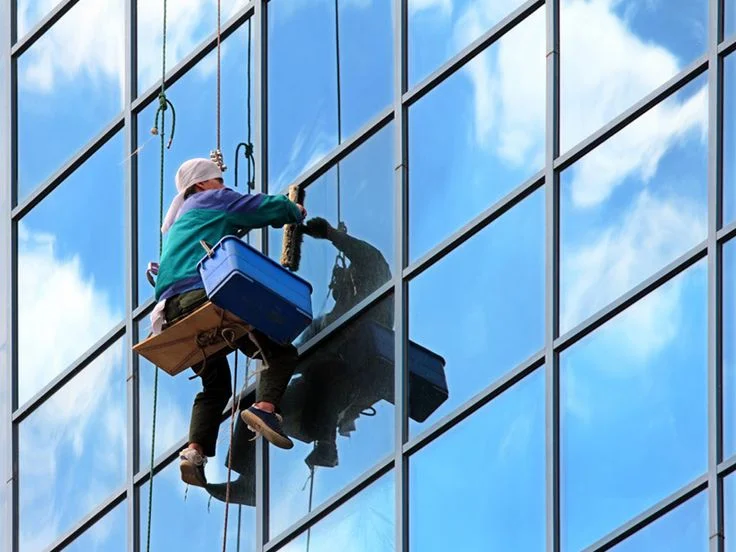
Above the fourth storey, poles run out of reach and the work shifts to rope access (IRATA-style abseil) or a building-mounted BMU. Our technicians work on a twin-rope system: one working rope with descender, one safety rope with backup device, both anchored to two independent structural points on the roof. Each carries a bosun's chair, helmet, harness, pole-bag and tethered tool lanyard — nothing held un-tethered above the second storey.
For Clifton and Sea View towers we coordinate with building management at least 72 hours ahead — informing residents below, barricading the drop zone, confirming anchor points and wind. We do not work above 25 km/h wind or in rain. High-rise work runs best November–February (lower humidity, less dust); May–August work starts at 06:00 and stops by 11:00 to avoid mid-day heat. Atrium and skylight work pairs with full house deep cleaning and floor cleaning for commercial buildings.
Service areas + same-day coverage
We cover metropolitan Karachi from our DHA Phase 4 base. Villa and shopfront work is same-day or next-day across DHA Phase 1–8, Clifton, Bath Island, Sea View, Bahadurabad, PECHS, North Nazimabad, Gulshan-e-Iqbal, Bahria Town and DHA City. High-rise rope-access jobs need a 5–7 day window for permits and weather. See cleaning services Karachi for the full coverage map. For coast-facing buildings we recommend a quarterly cycle; inland villas, twice-yearly (pre- and post-monsoon); shopfronts, a weekly or fortnightly contract.
Pricing
Pricing is by glass area, access difficulty and treatment depth. Cross-reference pest control prices Karachi 2026 and water tank cleaning Karachi if bundling on one visit.
| Service | Standard PKR | Notes |
|---|---|---|
| Villa windows (3-bed) | 8,000–14,000 | Inside + outside, pure-water finish |
| Villa windows (5-bed DHA villa) | 14,000–22,000 | Inside + outside, pure-water finish |
| Shopfront glass | 8–14 / sq ft | Min job PKR 3,500 |
| High-rise — pole-reachable (up to 4th floor) | 18–28 / sq ft | Pure-water pole, no rope |
| High-rise — rope-access (above 4th floor) | 35–55 / sq ft | Two-person rope team |
| Atrium + skylight | 40–65 / sq ft | Out-of-hours, includes barricading |
| Hard-water scale removal | +30–50% | Citric or glycolic pass |
| Post-construction glass | 45–75 / sq ft | Scrape + scale + pure-water |
| Mirror cleaning (per piece) | 350–800 | Ammonia-free, two-cloth |
Per-sq-ft bands drop with height and recurring frequency. Travel within the main city is included. For towers and atriums the survey is a separate visit; for villas and shopfronts the technician confirms on arrival.
How to book + what to expect on the day
WhatsApp us a few photos — wide shot of the building, close-up of any visible scale, plus height or square footage. We quote within the day. For ground-level work we confirm within two to three days; rope-access high-rise needs a site survey first, then schedule five to seven days out.
On the day, the team arrives with the pure-water plant, poles, surfactant and acid bottles, and (for high-rise) the rope-access kit. We brief security or the homeowner, set barricades, lay protective sheeting, and work top-down. A 5-bed villa runs three to four hours; a 12-storey tower face takes a full working day; a shopfront refresh, 30–60 minutes. If you are unhappy with any pane we return and re-do it — you do not pay twice.
Nest Fumigation Services Private Limited
Plot #14, 2/1 2nd Gizri Street, DHA Phase 4, Karachi 75500
Phone: +92-311-1101810
Email: contact@nestfumigationservices.com
Hours: Mon–Sat 09:00–17:00, Sun closed
Certifications: ISO 9001:2015, KCCI, SPMA, PPMA
Reviews: 143 verified Google reviews, 4.9★
Contact us to book a building glass cleaning visit, request a site survey for high-rise work, or set up a maintenance contract.
Frequently Asked Questions
How long does building glass stay clean in Karachi?
On an exposed coast-facing facade in Sea View or Clifton, dust and salt return within 2–3 weeks; mineral spotting sets in by 6–8 weeks. Inland villas hold a pure-water finish for 6–10 weeks. Shopfronts on busy roads need weekly or fortnightly attention.
Why does my glass have chalky spots even after cleaning?
Because the previous clean used tap water. Karachi's supply runs 300–400 ppm dissolved solids — mostly calcium and magnesium — that deposit as a chalky spot the moment water evaporates. Our system drops TDS to under 1 ppm before water touches glass.
Can you remove water-stain etching from monsoon haloes?
Light to moderate spotting yes — 5–10% citric acid pad, dwell 2–3 minutes, full pure-water rinse. Deep-set etching needs an 8–12% glycolic pass, sometimes two cycles. There is a point of permanent micro-etching where even acid cannot recover original optical clarity — at that stage the glass needs polishing or replacement, not cleaning.
Is rope-access safe on Karachi high-rises?
Yes when done correctly — IRATA-style twin-rope with two independent anchor points, dual descender + backup device, helmet, harness, bosun's chair, tethered tools. We coordinate with building management 72 hours ahead and barricade the ground zone. We do not work above 25 km/h wind, in rain, or in extreme heat.
Do you handle post-construction glass cleanup?
Yes, as a separate workflow — scrape with a sharp blade held flat at 30°, treat residue with citrus solvent, run a glycolic acid pass for set cement film, and finish with pure-water rinse. Most new-build handovers in DHA Phase 8, Bahria Town and DHA City need this before move-in.
Are the cleaners safe for silicone seals?
Yes. Pure-water and surfactant chemistry is silicone-safe. Citric and glycolic at our working concentrations do not affect silicone when dwell is controlled and rinsed thoroughly. We do not use xylene or strong alkaline caustic on facades — those soften seals.