







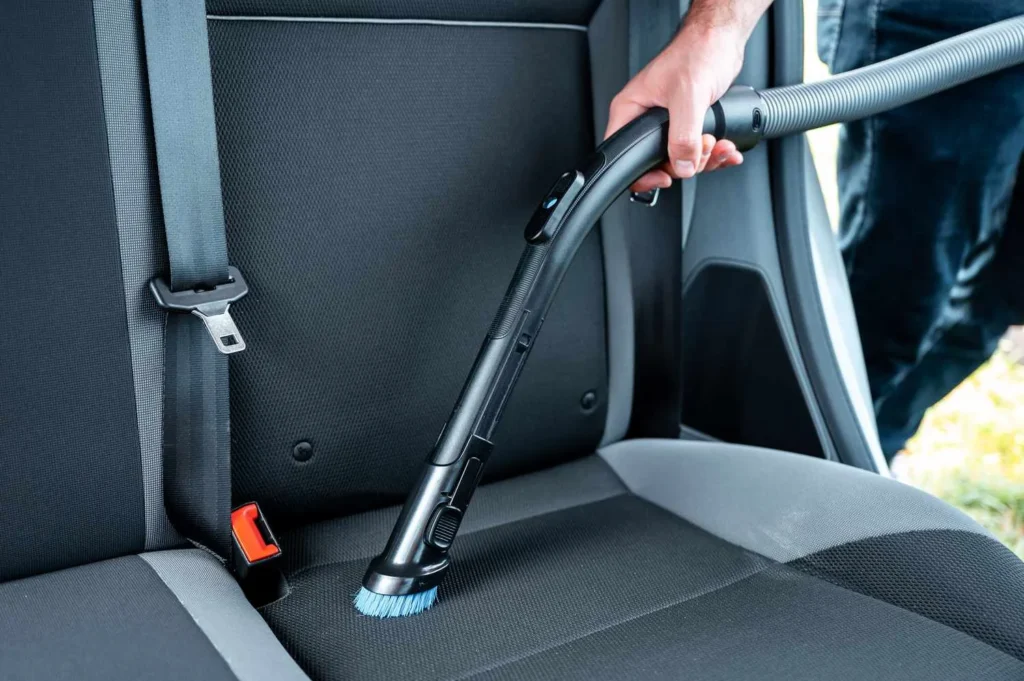
A car interior in Karachi takes more punishment than almost any soft surface in your home. School-run mornings leave biscuit crumbs and juice in the rear bench; mosque-day Fridays leave chai and pan masala in the third row of a 7-seater; the West Karachi sun bakes whatever was not cleaned by Sunday into the fabric until the monsoon turns the cabin humid and slightly sour. We at NFS have cleaned the seats of thousands of cars across DHA, Clifton, Bahria Town, Gulshan and PECHS — sedans, SUVs, 7-seaters, baby seats, taxis and fleet cars. Car seat cleaning is harder than sofa cleaning because the fabric is sealed inside a hot, humid, ventilation-limited steel box for ten hours a day. Our chemistry, drying discipline, and equipment are tuned to that reality.
The car seat fabric types we see in Karachi
Showroom paperwork in Pakistan rarely tells the whole story. Corolla "fabric" is a different polyester weave from Honda City "fabric", and Land Cruiser "leather" is rarely the same hide as Mercedes leather. We test under the seat-belt buckle bezel with our identification kit before any cleaner touches a visible panel.
Polyester fabric (Corolla, City, Civic, Sportage)
The commuter-fleet workhorse — tight polyester weave with thin foam backing. Tolerates hot-water extraction with a mildly alkaline pre-treat at pH 9–10. Main risk: over-wetting — push too much water in and it soaks the seat sponge, which then takes 24+ hours to dry and starts to smell. Short strokes, double dry passes, air mover at the door.
Microfibre and Alcantara-style
Synthetic with sub-one-denier fibre, feels like suede. Stain-resistant for thirty seconds then locks in. Hot-water extraction with soft-bristle scrub and a brief alkaline pre-treat. Pile direction matters at finishing. Drying: 2–4 hours with a fan.
Genuine leather (Land Cruiser, Prado, Fortuner, BMW, Mercedes)
Leather is a hide, not a textile, and cracks under alkaline chemistry. Three steps: damp microfibre wipe with neutral leather soap at pH 6.5–7.5, distilled-water rinse, beeswax-and-lanolin conditioning cream buffed to a soft sheen.
Bonded leather and PU
A thin polyurethane skin glued to fabric backing, sold as "leather" by many Tariq Road upholsterers. Neutral cleaner; skip conditioner (will not absorb), apply protective wax. Bonded leather peels if scrubbed — no chemistry rescues a peeling surface.
Velour and unknown blends
Velour traps dust at the base of a directional pile: soft horsehair brush, low-moisture shampoo, pile-lift finish, steam only in short bursts. Aftermarket reupholstery from Bohri Bazaar cloth is usually a polyester-cotton blend with no care label — default to low-moisture encapsulation, neutral pH, hidden-seam test.
Upholstery × method × drying reference
| Upholstery | Method | Drying time |
|---|---|---|
| Polyester fabric (Corolla/City) | Hot-water extraction, mild alkaline pre-treat | 3–5 hours |
| Microfibre / Alcantara-style | Extraction, soft brush, pile-set | 2–4 hours |
| Genuine leather | Wipe, rinse, condition | 30 minutes |
| Bonded leather / PU | Neutral wipe + protective wax | 30 minutes |
| Velour / plush | Low-moisture shampoo, pile-lift | 2–3 hours |
| Unknown blend | Low-moisture encapsulation, neutral pH | 3–5 hours |
Our 3-stage cleaning protocol — chemistry, equipment, drying
Every car follows the same three-stage sequence. The chemistry and tools change with the fabric; the order and the rigor never do.
Stage 1 — Inspection and dry vacuum
The first fifteen minutes are spent looking, not cleaning. We pull seats on their rails, lift mats, photograph pre-existing damage, and run a deep dry vacuum with a HEPA-filtered upholstery head into every crevice and seat-belt slot. In a typical Karachi family sedan we pull 40–80 grams of dust and grit out at this step alone. The single biggest reason cheap detailing leaves a muddy residue is skipping this — once water hits unvacuumed dust, you have made paste.
Stage 2 — Pre-treat, shampoo, extract
On polyester and microfibre, a mildly alkaline pre-treat at pH 9–10 dwells 5–10 minutes so the surfactants — coconut-derived cocamidopropyl betaine and sodium lauroyl sarcosinate — emulsify skin-oil and food-grease. Then hot-water extraction at 70–80°C; hot enough to lift oil, not hot enough to set protein. A 4-inch hand tool reaches bolsters and behind headrests. Every panel: one wet pass, two dry. On natural-fibre or unknown blends we switch to low-moisture encapsulation — neutral cleaner crystallises around soil and is vacuumed out as dry residue.
Stage 3 — Stain treatment, odour kill, final dry
Stubborn stains are treated individually. An enzyme-based odour treatment then runs across the cabin with a 10-minute dwell, before a final extraction pass. A high-velocity air mover runs through the open driver's door for 45–90 minutes; passive evaporation in Karachi humidity takes 18+ hours and almost guarantees a sour smell, while active drying brings cushion-fill moisture below 12% in under three hours. Optional add-on: hospital-grade quaternary ammonium fog for cars carrying infants or immunocompromised passengers.
What we use — and what we will not
Standard chemistry: coconut-derived nonionic surfactants, citric acid for pH balance, a protease enzyme blend for protein, citrus d-limonene solvent for oils. Infant car seats: plant-derived range only — no synthetic fragrance, no optical brighteners. No chlorine bleach, no ammonia on leather, no petrol-pump "interior shampoo" sprays loaded with silicone gloss agents (they leave a tacky residue), no "new car smell" sprays.
Common Karachi stains: chai, biscuit, pan masala, vomit, monsoon mud, pet hair, baby blowouts
Chai, coffee and greasy food
Chai is the single most common car-seat stain in this city. Tannin-based — dilute citric acid at pH 4–5 followed by hot-water extraction. Set-in chai heat-baked through a Karachi summer can leave a faint yellow shadow. Greasy food (biscuit, paratha, biryani oil): solvent first then surfactant — citrus d-limonene to the spot, 5-minute dwell, blot, extract.
Pan masala, gutka and vomit
Pan masala needs combination treatment — citrus solvent for the oil-soluble component plus enzyme pre-treat for saliva and protein, 15-minute dwell, extraction. Vomit is the worst car stain by a wide margin — a protein-fat-acid cocktail that soaks into foam within minutes. Always pre-treat cold; hot water sets protein. Protease enzyme first with 15-minute dwell, citrus solvent for the oil component, then hot extraction. For deep contamination we sub-surface inject enzyme into the foam, 30-minute dwell, extract. Without this step the visible stain lifts but the smell returns within 48 hours.
Baby blowouts and infant car seats
Young families in DHA, Clifton and Bahria book us regularly. Where possible we remove the cover and machine-wash; one-piece moulded seats get the enzyme protocol in place with a longer drying window. Plant-derived chemistry only — no synthetic fragrance, no optical brighteners.
Monsoon mud, pet hair, cigarette smell, dust shadows
Wet mud should never be rubbed in. Let it dry, vacuum, treat the shadow with neutral cleaner. Pet hair is mechanical — rubber pet-hair brush before extraction. Tobacco smell in the cushion fill responds to a cabin-fog enzyme treatment with doors closed and AC on recirculate for 30 minutes; sometimes two visits a week apart are needed. The most common "stain" of all is not a stain — fine atmospheric dust pressed into the fabric by sitting, showing as a darker shadow on the seat base. Stage 1 vacuum lifts most; Stage 2 shampoo, the rest.
Leather conditioning for Karachi's heat + humidity cycle
Leather seats in Karachi live a brutal life. A car in a Bahria Town driveway in June sees cabin temperatures over 70°C; at 8 AM in August the same car sits in 85% humidity. That heat-humidity-heat cycle pulls oils out of the hide, floods it with damp, then bakes it dry. Untreated leather cracks along the bolster seams within 12–18 months — we have seen it on three-year-old Land Cruisers whose owners thought leather was maintenance-free.
Our conditioning protocol: beeswax-and-lanolin cream applied with a soft pad along the grain, 10-minute absorb, buffed to a soft sheen — never high gloss. High-gloss products contain silicone, which seals the hide and blocks future conditioner absorption. For leather to last the life of the car, clean-and-condition every six months April–October and every nine months across winter. Pair with our full house deep cleaning or sofa cleaning and both jobs land on the same day.
Service areas and same-day coverage
We service the entire main bowl of Karachi — DHA Phases 1–8, Clifton Blocks 1–9, Bahria Town Karachi, Bahadurabad, PECHS, Tariq Road, Gulshan-e-Iqbal, Gulistan-e-Jauhar, North Nazimabad, Federal B Area, Korangi, SITE and Malir Cantonment. Our team arrives at your gate, basement parking or driveway with the portable extractor, chemistry, leather kit and air mover — no workshop visit needed. Same-day slots usually available if you call before 11 AM. No travel charge within the main city. Taxi, pool-car, ambulance and ride-share fleets — monthly contracts with priority scheduling, detailed on our cleaning services in Karachi hub.
Pricing
Priced by vehicle size, upholstery and soiling. Heavily soiled cars, sub-surface treatments and conditioning add to the base. Combined bookings — car plus sofa, or car plus full-house deep cleaning — are discounted.
| Vehicle | Fabric upholstery | Leather upholstery |
|---|---|---|
| Sedan (Corolla, City, Civic, Yaris) | PKR 4,500–6,000 | PKR 6,500–8,500 |
| Compact SUV (Sportage, Tucson, BR-V) | PKR 5,500–7,500 | PKR 8,000–10,000 |
| Full SUV (Fortuner, Land Cruiser, Prado) | PKR 7,500–10,000 | PKR 11,000–14,000 |
| 7-seater MPV (Alphard, Voxy, Stepwgn) | PKR 8,000–11,000 | PKR 12,000–15,000 |
| Sub-surface vomit / urine injection | PKR 1,500–2,500 per seat | — |
| Leather conditioning only (no clean) | PKR 4,000–6,000 | — |
| Cabin disinfection fog add-on | PKR 1,500–2,500 | — |
| Infant car seat (full clean) | PKR 1,800–2,500 | — |
Final pricing is confirmed on the day. Bundled with our pest control or with sofa/mattress work, the combined rate is more economical than booking separately.
How to book and what to expect on the day
WhatsApp or call with three pieces of info: car make and model, upholstery (fabric or leather), and your area. We confirm a slot within one to three working days — same-day if you call before 11 AM. Fleet bookings: scheduling works around your operational cycle.
A sedan takes 90–120 minutes; a full SUV with leather conditioning, 2.5–3 hours; a 7-seater MPV with sub-surface vomit treatment, up to 3.5 hours. Park near a 230V outlet; you do not need to be present. The technician walks you through the result and confirms the price. If you are unhappy with anything, we return and address it at no charge.
Nest Fumigation Services Private Limited
Plot #14, 2/1 2nd Gizri Street, DHA Phase 4, Karachi 75500
Phone: +92-311-1101810 · Email: contact@nestfumigationservices.com
Hours: Mon–Sat 09:00–21:00, Sun closed
Certifications: ISO 9001:2015, SPMA, PPMA, KCCI · 175 reviews (4.9★) · Founder: Saad Danish
Contact us to book, or browse related services: sofa cleaning, carpet cleaning, mattress cleaning, and full house deep cleaning.
Frequently Asked Questions
How long does a car interior take to dry after cleaning?+
A fabric seat cleaned by hot-water extraction is touch-dry in 2–4 hours and fully dry through the cushion in 8–12 hours. Microfibre: 2–3 hours. Leather: dry immediately. We run a high-velocity air mover through the open driver's door for 45–90 minutes — the single biggest reason our cars come out without a sour smell the next morning.
Can the car be driven the same day?+
Yes. Once the air mover has run for 45 minutes the seats are dry enough for normal use. Crack a window for the next 4 hours if parked outside, or run AC on fresh-air intake for the first ten minutes.
Are the chemicals safe for children and pets?+
Yes. For cars carrying infants we use a plant-derived range — coconut-derived surfactants, citric acid, no synthetic fragrance, no optical brighteners. Cabin disinfection fog available as add-on for immunocompromised passengers or post-stomach-bug clean-up.
Can you remove vomit or pet urine smell completely?+
Often yes — but it requires sub-surface treatment. Surface cleaning alone lifts the visible mark while the smell returns within days as foam dries. Proper removal is enzymatic injection into the foam, 30-minute dwell, full extraction — an add-on per affected seat. For repeatedly contaminated third-row benches, foam replacement at an upholsterer is sometimes more economical — we will tell you which is the right call.
Do you clean leather car seats and condition them?+
Yes. Neutral leather soap wipe at pH 6.5–7.5, distilled-water rinse, beeswax-and-lanolin cream buffed to a soft sheen. Conditioning is included because untreated leather cracks within 12–18 months in Karachi's heat-humidity cycle. Full-grain and top-grain only — bonded leather is cleaned and waxed but we do not promise to revive a peeling surface.
How often should car seats be professionally cleaned in Karachi?+
Adult family car: every 9–12 months. School-run with young children: 4–6 months. Pet cars: 3–4 months. Taxi and ride-share fleets in daily use: monthly via fleet contracts. If you can see a darker shadow on the driver's seat compared to the back, you have waited too long.