







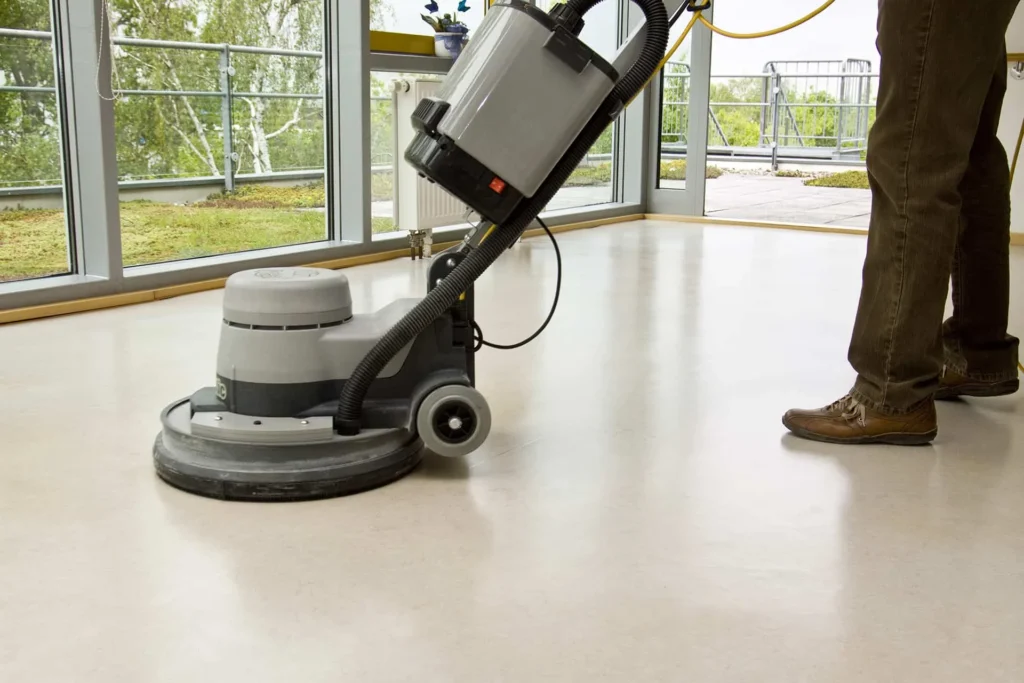
Marble, granite and terrazzo are stones, not surfaces. They wear, they etch, they trap dust in their pores, and in a Karachi home — bare feet, monsoon mud, kitchen acids and atmospheric dust landing on the same floor every day — they age faster than the customer expects. Our team at NFS has been polishing stone floors across DHA, Clifton, Bahadurabad, Gulshan, North Nazimabad and Bahria Town for years, and the lesson keeps surfacing: floor polishing is a sequence of mechanical work, then chemistry, then a protective coating — every step chosen for the specific stone. A 25-year-old terrazzo lobby in Saddar needs a different process from a freshly laid Botticino floor in Phase 6. On this page we explain how we approach each stone, what the grits do, why crystallisation matters, which sealer is right where, and what the work costs.
Stone types we polish in Karachi
The first thing our technician does on arriving is identify the stone. Many older Karachi homes have floors sold as "marble" that are actually limestone, travertine, or marble-look terrazzo. Pricing, chemistry and grit progression change with the answer, so we test before we cut.
Marble (Botticino, Carrara, Ziarat white, Verona)
Marble is metamorphosed limestone — predominantly calcium carbonate (CaCO3) with dolomite veins and trace minerals. DHA and Clifton bungalows are dominated by Italian Botticino and Carrara; older homes carry local Ziarat white and Verona. Calcium carbonate is soft (Mohs 3) and reactive — every acid spill etches it, and the etch is a chemical change, not a stain. We polish marble with the full diamond sequence (50 to 3000 grit) followed by crystallisation, which converts surface calcium carbonate into harder calcium fluorosilicate. The result is the deep, glass-like reflection every marble customer wants, on a surface that resists everyday acid contact far better than raw stone.
Granite (Black Galaxy, Tan Brown, Kashmir White)
Granite is igneous — quartz, feldspar and mica fused under pressure — significantly harder than marble (Mohs 6-7). Karachi kitchen countertops are mostly granite: it resists knife scratches and does not etch from kitchen acids. Granite does not respond to crystallisation; the calcium-carbonate reaction is irrelevant on a silicate rock. We polish mechanically to high grit (3000, sometimes 8000 on countertops), then seal with penetrating silicone or lithium silicate. A Karachi granite countertop done correctly should not need re-polishing for five to seven years — only re-sealing every 12-18 months.
Terrazzo (Karachi's 1980s lobbies and stairwells)
Terrazzo is marble or granite chips set into a cementitious binder, ground flat and polished. It is everywhere in older Karachi — apartment lobbies, 1980s commercial stairwells, school corridors. The chips behave like parent stone; the binder is the weak point. After thirty years of foot traffic the binder sits below the chips, leaving the floor uneven to touch. We re-grind chips and binder flat together, polish through the grits, and finish with a lithium silicate densifier that hardens the cement matrix permanently. One of the most rewarding stones to restore.
Engineered stone, limestone, travertine
Engineered stone (Silestone, Caesarstone and local quartz composites) is ~90% crushed quartz in polymer resin. The resin softens under diamond-pad heat, so we work at low speed with copious water and never crystallise. Most scratches respond best to a buff-and-wax sequence. Limestone and travertine (mostly Turkish or Egyptian imports) are softer and more porous; we polish only to 800 or 1500 grit and seal aggressively because they soak up chai, oil and red wine in seconds.
The diamond grit progression — why 6 passes, not 2
A polishing job that jumps from coarse straight to fine is a job done wrong. The pads in our progression — 50, 200, 400, 800, 1500, 3000 — each have a specific role; skipping grits leaves scratch patterns no later pass can remove.
- 50 grit — cutting pass. Lippage ground flat, deep etches levelled, fifteen years of traffic reduced to fresh stone. The floor looks worse after this pass — uniformly matte and grey. That is correct.
- 200 grit — first refinement. Removes 50-grit scratches and flattens the surface. A 200-grit finish alone is honed-matte — fine for commercial, never for a drawing room.
- 400 grit — removes 200-grit scratches; develops a faint sheen.
- 800 grit — the floor begins to reflect light. Cheap Karachi jobs stop here.
- 1500 grit — clarity. Reflections sharpen and colour deepens because light penetrates the polished surface rather than scattering off scratches.
- 3000 grit — final mirror. The deep wet-look reflection that distinguishes a properly polished marble floor from a merely shiny one.
We run the sequence with planetary diamond polishing machines — HTC and Husqvarna in our fleet — at controlled water flow. Water cools the diamonds, suspends the slurry, washes cut stone out of the pad; without it the pads glaze and stop cutting within minutes. On site this means tarps, continuous wet-vacuum, and a full wipe between every grit. Cross-contamination — a 200-grit pad picking up loose 50-grit slurry — is the most common defect when called to fix another company's failed job. For grout lines, edges and corners we use a hand-held angle grinder running the same grits. Edges are where a job is judged.
Crystallisation chemistry — what it actually does to marble surfaces
Crystallisation distinguishes a competent marble polish from a great one — the step most often skipped by cheap operators. The polished surface is dressed with a potassium silicofluoride (or magnesium fluorosilicate) solution — formulated with a fluoropolymer and fatty-acid carrier — and worked into the stone with a steel-wool pad under a weighted single-disc machine. Friction heat at the pad face (60-80°C) activates the reaction. Surface CaCO3 reacts with the fluorosilicate; the product is calcium fluorosilicate (CaSiF6) — significantly harder than the parent carbonate, not water-soluble and not acid-soluble at typical kitchen concentrations.
In practice: the surface becomes harder (foot traffic that dulls raw polished marble in three months leaves crystallised marble unchanged); acid resistance improves (lemon juice marks but a quick wipe lifts it — raw polish would have etched); the reflection deepens; and maintenance becomes a powder-and-pad routine that re-densifies the surface without a full re-polish.
Crystallisation is not a coating. No film sits on the stone — the reaction happens at the surface, so it cannot be peeled or scraped off. It must come after the grit sequence: it modifies the polished surface already there. For coloured marbles we adjust — pink and beige can yellow under standard chemistry, so we switch to a low-pH neutral crystalliser. Black marbles show every micro-scratch from the steel-wool pad; we double-vacuum first.
Polishing powders by stone type
Beyond crystallisation, certain stones respond to polishing powders combining fine abrasive (aluminium or cerium oxide) with oxalic acid or tin oxide chemistry — chemical etch followed by mechanical buffing. We use them on travertine and limestone (too soft for crystallisation), on onyx and decorative panels (crystallisation heat risks fracture), and for spot restoration on otherwise good marble. Cerium oxide is the workhorse for marble repair; oxalic-acid powders work on travertine.
Sealers: acrylic vs penetrating silicone vs lithium silicate — when each is right
Many Karachi jobs go wrong here — operators default to whatever is cheapest and apply it to every stone. We choose by stone and application.
Acrylic sealers are emulsified polymers laying a thin film on top. Cheapest, immediate high gloss, wear off within months under foot traffic, yellow under UV. We use them only on display surfaces — never high-traffic floors.
Penetrating silicone sealers (siloxane / silane) soak into the pores, react with moisture, and leave a hydrophobic layer 2-5mm below the surface. No film to scuff, no change to appearance. Our default for granite countertops and marble floors where the customer wants a natural look — right for almost every Karachi kitchen.
Lithium silicate densifiers are the most technically sophisticated. The chemistry penetrates and reacts with free calcium or silica to form calcium silicate hydrate — the compound that gives Portland cement its strength. It densifies the stone permanently, increases hardness, reduces porosity from the inside. We use it on terrazzo (the cement binder benefits enormously), commercial floors needing maximum durability, and as a complement to crystallisation on premium marble. Slower (two coats, 4-hour interval) but lasts years longer than any film sealer.
On pH: crystallised marble sits at pH ~8. Penetrating silicones (pH 6-8) and lithium silicate (pH 11-12) are compatible. Acidic sealers over crystallised surfaces neutralise the chemistry — we never apply acidic treatments after crystallisation.
Karachi-specific: monsoon humidity, kitchen acids, embedded construction dust
Three forces age Karachi stone floors faster than chemistry alone can fight.
Monsoon humidity wear
Karachi humidity sits at 60-80% most of the year and breaches 85% in July-September. Vapour condenses on cool stone overnight; bare feet press microscopic moisture into the surface through the day. On uncrystallised marble this accelerates polish breakdown — a fortnight in monsoon costs you what a month does in winter. Crystallised marble holds up dramatically better; the fluorosilicate layer is unaffected by atmospheric moisture. For post-monsoon recovery in October-November we offer a single-pass re-crystallisation that restores gloss in one day per floor.
Kitchen acid etching (citrus and chai)
Pakistani kitchen acids — limes, lemons, chai tannins, achaar oil, tamarind paste — etch raw marble within seconds. Crystallisation extends the response window from seconds to minutes, but no chemistry makes marble fully acid-proof. For marble kitchen countertops we recommend granite or quartz at the splash zone, or full crystallisation plus penetrating sealer plus immediate spill-wiping. Marble in a Karachi kitchen is high-maintenance regardless of polish; chemistry buys reaction time, nothing more.
Construction dust embedded in older marble
A fifteen-year-old DHA bungalow's floor has absorbed atmospheric particulate, skin oil, and the dust of every renovation. When we run the 50-grit cut, the slurry comes off dark grey — embedded dirt being lifted. The cutting pass restores the actual colour of the stone; after deep restoration the floor often looks several shades lighter than the customer remembered. For post-renovation polishing — common when Phase 4 or 6 renovations dump concrete and plaster dust on existing floors — we lead with a wet decontamination wash, a single 800-grit refresh, then re-crystallise. Faster and cheaper than full restoration.
Pricing
We price by stone type, floor condition and sealer choice. Standard bands for Karachi residential work below; commercial is quoted per site.
| Stone + condition | Process | PKR per sq ft |
|---|---|---|
| Marble, light wear (re-polish only) | 800 → 3000 grit + crystallisation | 90–130 |
| Marble, medium wear | 200 → 3000 grit + crystallisation | 140–180 |
| Marble, heavy wear or post-renovation | Full 50 → 3000 grit + crystallisation + sealer | 200–260 |
| Granite floor or large surface | Mechanical polish + penetrating silicone sealer | 160–220 |
| Granite countertop (per running ft) | Mechanical polish + sealer | PKR 800–1,200/ft |
| Terrazzo, residential | Full grit + lithium silicate densifier | 180–240 |
| Engineered stone / quartz | Buff + wax sequence | 150–200 |
| Limestone / travertine | Honed finish + penetrating sealer | 150–200 |
| Add-on: lithium silicate upgrade | Over standard sealer | +40–60 |
| Add-on: post-monsoon re-crystallisation | Single pass only | 60–90 |
| Minimum site call-out | — | PKR 15,000 |
Pricing varies less by locality than by access. Ground-floor villas with off-street parking are simplest; high-floor apartments where equipment must be carried by hand cost more in labour. We confirm exact figures after a site visit.
Service areas and how we schedule (it's a 2-day job for most homes)
Most Karachi residential floor-polishing jobs are a two-day project. Day one is the dust-controlled grit sequence and (for marble) crystallisation. Day two is sealer application, edge work, and customer walk-through. The rooms are unusable for that duration — equipment, water, slurry and cure times all demand it. We discuss room sequencing at booking so the family can shift living spaces as we work.
We cover DHA (all phases), Clifton (Block 1-9 and the Cantt), Bahadurabad, KDA, PECHS, Gulshan-e-Iqbal, North Nazimabad, Bahria Town and Bath Island, and travel to Hyderabad and Thatta on request. No separate travel charge within main Karachi.
For a quote, send photos on WhatsApp (close-up of damage plus a wide shot) and approximate square footage. We give a price band within an hour during office hours and confirm a slot — most jobs start within five to ten days.
Read more about our wider cleaning services in Karachi, including floor cleaning (the routine-maintenance counterpart to polishing) and full house deep cleaning. For commercial premises we often pair floor polishing with pest control on the same visit.
Nest Fumigation Services
Plot #14, 2/1 2nd Gizri Street, DHA Phase 4, Karachi 75500
Phone: +92-311-1101810
Email: contact@nestfumigationservices.com
Hours: Mon–Sat 09:00–21:00, Sun closed
Certifications and memberships: ISO 9001:2015, KCCI, SPMA, PPMA
Founder: Saad Danish — 175 Google reviews, ★4.9 average
Contact us to book a site visit.