







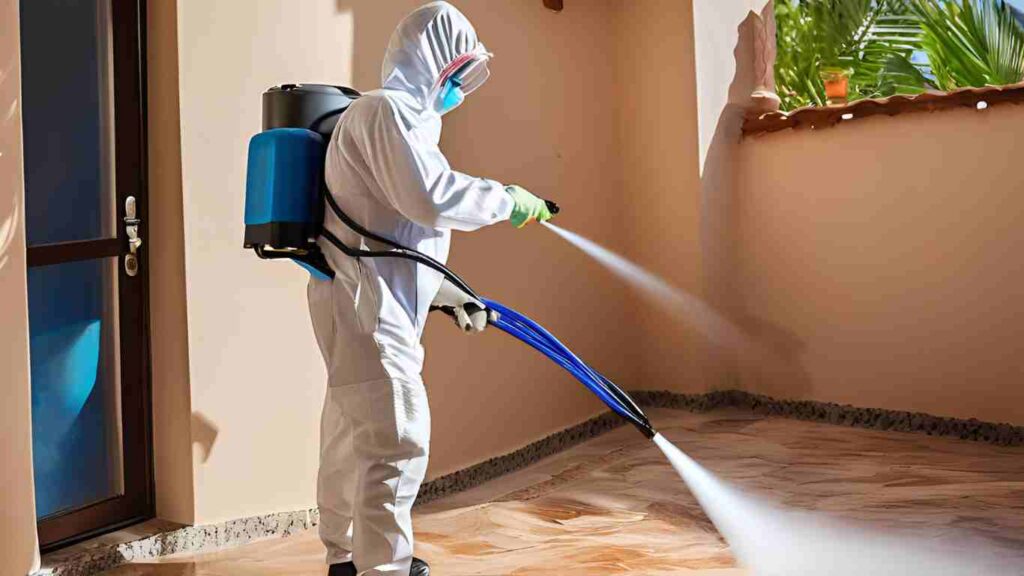
Gulshan-e-Iqbal does not behave like the planned coastal neighbourhoods we service in Phase 4 and Clifton, and it does not behave like the dense commercial-residential grid of Bahadurabad. It is a sixteen-block belt of mixed apartment buildings and 240-to-400-square-yard plot houses, woven through by the University Road commercial corridor, fed at the east end by Safari Park and Aladdin Amusement Park, and pinned at the west by NIPA Chowrangi and the older Pahar Ganj lanes adjoining Block 1. Four calls drive most of our Gulshan volume: apartment-stack cockroach migration through shared risers, Aedes aegypti [1] pressure from park-adjacent stagnant pools after monsoon, Rattus rattus activity along the University Road food belt, and Coptotermes heimi in the 1990s-stock plot houses around Blocks 5, 6 and 13. We at Nest Fumigation Services run a Gulshan-specific protocol for each. This page documents how.
Pest profile of Gulshan-e-Iqbal
The jobs we have logged across Blocks 1 through 16 since 2024 cluster into a recognisable set shaped by Gulshan's built form rather than its postcode. A typical Gulshan address is one of three things: a third-to-eighth-floor flat in a 1990s or 2000s apartment block, a single-family plot house on a 240-or-400-square-yard lot built between 1992 and 2008, or a ground-floor commercial unit on University Road. The pest pressure on each is structurally different, and a generic treatment quoted without understanding which type the address is will under-treat one and over-treat another.
Cockroach calls are the highest-volume residential category. Blattella germanica dominates the apartment-flat calls, entering upper floors through the shared kitchen-stack riser and bathroom waste-line. Periplaneta americana dominates the plot-house calls, entering through the perimeter drain and boundary-wall joins. Mosquito pressure is unusually high for an inland neighbourhood because of Safari Park, the Aladdin lake feature, and the open nullah drainage — Culex quinquefasciatus dominates the pre- and post-monsoon windows, Aedes aegypti the July-to-October monsoon ramp. Rodent calls concentrate along the University Road commercial belt and NIPA Chowrangi food clusters, with Rattus rattus and Rattus norvegicus moving into residential blocks behind the frontage. Termite calls run through the 1990s-stock plot houses in Blocks 5, 6, 10, 13 and parts of 16, with Coptotermes heimi the dominant species and Heterotermes indicola secondary.
The city-wide picture is mapped on our Karachi pest control hub. The neighbourhood-specific protocol below is what we run on a Gulshan job.
Nearby service areas: Gulistan-e-Jauhar service area, North Nazimabad service area, and PECHS service area.
How we treat apartments differently from plot houses
The single most important operational distinction in Gulshan is the difference between treating an apartment flat and treating a plot house. The chemistry placement, access logistics, and durability are all different, and conflating the two is the most common reason a previous fumigation in Gulshan did not hold.
Apartment flats — the stack-effect problem
A Gulshan apartment building is a vertical column of flats sharing two critical infrastructure features: a kitchen plumbing riser connecting every sink and floor drain from ground to roof, and a soil stack doing the same for every bathroom. Blattella germanica on the sixth floor is almost never a sixth-floor problem. It is a building problem — originating at a poorly maintained ground-floor flat or the basement drainage junction — that ascends the riser at night through the trap seal and exits at whichever upper-floor kitchen has the most accessible food residue. Treating only the booking flat produces a clean kitchen for three to four weeks, after which migration resumes.
Our apartment protocol treats the riser pathway. On the first visit we apply non-repellent indoxacarb gel bait at the floor drain, under the sink, behind the kickplate, and at the wall-floor junction in the kitchen and bathrooms. We then ask the resident whether they can give us access to the immediate neighbour — directly above, directly below, same shared riser — for perimeter-only treatment at the floor-drain access. Where we can treat two or three connected flats simultaneously the result holds; where we cannot, we seal the trap and floor-drain interface as a barrier. Chemistry actives are the same as our general residential line — indoxacarb gel-bait, fipronil [2] 5SC for perimeter, deltamethrin 2.5 EC for spot application — but placement is riser-led, not flat-led. Full chemistry detail is on our cockroach treatment page.
Plot houses — the perimeter and soil problem
A Gulshan plot house is a self-contained system. Cockroach pressure enters through the perimeter drain, the boundary-wall joins, and any exposed sewer cleanout, not through a shared building riser. The species shifts from Blattella germanica to Periplaneta americana, and the chemistry shifts with it — heavier fipronil 5SC perimeter application around the boundary wall and the sewer junction, indoxacarb gel-bait reserved for indoor harborage, deltamethrin 2.5 EC for the back-yard and external pipe runs. Termite risk in 1990s-stock plot houses is real and treated as a separate booking line — see the soil-injection protocol on our termite control page. The result of a plot-house treatment holds longer than an apartment treatment because the boundary is closed.
Mosquito pressure from Safari Park, Aladdin, and the open drainage
Mosquito pressure on Gulshan blocks closest to Safari Park (6, 13 and 14), the Aladdin lake feature (14), and the older open nullah drainage through Blocks 1, 2 and the Pahar Ganj boundary is measurably higher than the Gulshan average. Culex quinquefasciatus, the southern house mosquito, breeds in organically polluted standing water — the open nullah, choked street drains, stagnant pockets at the park edge — and dominates the pre-monsoon and post-monsoon windows from late April through June and again from September through November. Aedes aegypti, the day-biting dengue vector, breeds in clean standing water — tanks with unsealed lids, AC condensate drip pans, plant saucers, and rain-fed puddles on flat rooftops during the July-to-October monsoon ramp.
Our standard Gulshan mosquito visit runs two operations. First, larvicide at accessible breeding sites — temephos for organically loaded open-drain water, pyriproxyfen (an IGR) for rooftop tank treatment where water-supply contact is a concern. Second, adulticidal ULV fogging at the property perimeter, boundary wall and rooftop at dusk when Culex quinquefasciatus activity peaks, using deltamethrin 2.5 EC or bifenthrin. The fog kills airborne adults; the larvicide breaks the next-generation cycle so the call does not recur in three weeks.
For AMC customers in Blocks 6, 13 and 14, we add a monsoon-prep visit in April or May covering perimeter ULV fogging, larvicide of accessible rooftop tanks, and inspection of the building drainage line. Pre-monsoon scheduling produces measurably better outcomes than reactive booking.
Rodent control along University Road and NIPA Chowrangi
The University Road commercial corridor and NIPA Chowrangi food cluster are the rodent pressure-point for the western half of Gulshan, and residential calls from the back-of-frontage lanes in Blocks 1, 2 and 3 are downstream of it. Rattus rattus, the roof rat, and Rattus norvegicus, the brown or sewer rat, move along the commercial belt — bakeries, fast-food outlets, karyana stores along University Road, and the food units around NIPA — and from there into storage rooms, basement parking and back stairs of the residential blocks behind. Mus musculus, the house mouse, appears more in older flats further from the commercial line.
Our standard residential rodent protocol places tamper-resistant bait stations at the boundary wall on a six-metre interval, using bromadiolone [3] at 0.005% in a paraffin-block formulation for the first round and brodifacoum [3] at 0.005% for sustained pressure. Snap traps go in storage closets, basement parking corners, and the wall-floor junction of residential common areas. For plot houses, the boundary line is augmented with snap traps in kitchen cabinetry and the rooftop water-tank room.
Where the booking is in a Block 1, 2 or 3 lane immediately behind a University Road frontage, we tell the customer that residential treatment alone will not close the call — bait gets ignored when a richer food source sits twenty metres away. The honest response is a sustained residential AMC at monthly cadence, or a separate commercial booking at the source. Pricing detail for both routes is on our Karachi 2026 pricing page.
Termite in the 1990s-stock plot houses
A meaningful slice of the Gulshan plot-house stock — particularly Blocks 5, 6, 10, 13 and parts of 16 — was built between 1992 and 2005, with original wooden joinery and foundation slabs placed before pre-construction termite treatment became routine. Coptotermes heimi, the dominant subterranean termite species in coastal Sindh, finds these properties readily. Swarming in late March and early April is the visible diagnostic; underlying colonies have typically been active for two to four years by then.
Our standard treatment is post-construction soil injection at 30-centimetre intervals along the inside plinth wall using fipronil at 2.5g/L to refusal, with a 12-month written warranty extendable to 5 years on an AMC. For wooden joinery already showing activity — hollowed door frames, soft skirting, mud tubes inside cupboards — we add localised injection around the affected timber and a borate surface application where the timber is structurally intact but at risk. Full protocol detail is on our termite control page.
Seasonal pest cycle in Gulshan-e-Iqbal
Gulshan's pest cycle follows the standard Karachi pattern with two local amplifications. Safari Park, Aladdin and open-nullah pressure stretches the Aedes aegypti and Culex quinquefasciatus windows by roughly four weeks on either side of the Karachi-average ramp. The 1990s-stock plot houses concentrate termite swarming into a tight late-March to mid-April window.
| Month | Cockroach | Mosquito | Rodent | Termite |
|---|---|---|---|---|
| January | low–medium | low | medium | low |
| February | low–medium | low | medium | low |
| March | medium | low | medium | swarming risk |
| April | medium | rising | medium | swarming peak |
| May | medium–high | high (Culex) | medium | active |
| June | high | high | medium | active |
| July | high | peak (Aedes + Culex) | medium | active |
| August | high | peak | medium | active |
| September | high | peak | medium | active |
| October | medium–high | high | medium | active |
| November | medium | medium | medium | low |
| December | low–medium | low | medium | low |
A Gulshan apartment AMC should be weighted to May–October for the riser-cockroach and Safari-Park-mosquito windows; a plot-house AMC should follow a balanced quarterly cadence with a termite inspection layered in at the March-to-April swarming window.
Service blocks and turnaround
We service the full Gulshan-e-Iqbal catchment from our DHA Phase 4 office. Drive time to NIPA Chowrangi is 25 to 35 minutes depending on Sharah-e-Faisal and University Road traffic; the residential blocks behind are within five to fifteen minutes once we are on site, and the eastern blocks toward Safari Park and Aladdin add another ten minutes. We accept bookings across:
- Blocks 1, 2 and 3 around NIPA Chowrangi and the western University Road frontage
- Blocks 4, 5 and 6 — central residential stretch including older plot-house lots
- Blocks 7 and 8 — the apartment-heavy mid-belt
- Blocks 9, 10 and 11 — Civic Centre side and the lanes feeding it
- Blocks 12, 13 and 14 — Safari Park and Aladdin adjacency
- Blocks 15 and 16 — eastern end toward Gulistan-e-Jauhar boundary
- Adjoining Pahar Ganj lanes where the booking is on a shared boundary
Standard turnaround for a one-off booking is 24 to 72 hours. AMC customers are scheduled into a fixed cadence — typically Tuesday or Friday — and get same-day callback for emergencies. There is no travel surcharge on any Gulshan block.
Pricing for Gulshan customers
Gulshan-e-Iqbal is priced at the same PKR rates we charge across DHA, Clifton, PECHS and Bahadurabad. There is no Gulshan postcode adjustment and no apartment-versus-plot-house pricing differential — the treatment work differs but the per-visit rate does not. Typical residential ranges:
Much of Gulshan-e-Iqbal is apartment stock where the building committee, not the individual flat, holds the contract; if that describes your block, our housing society pest control in Karachi page covers common-area chemistry, per-unit Blattella germanica gel work inside flats, and the monthly visit log we hand to society admin.
- General fumigation (single visit, all common pests): PKR 3,500–6,500 for a 1-bed flat, PKR 5,500–11,000 for a 2–3 bed flat or small plot house, PKR 9,000–18,000 for a larger plot house.
- Cockroach gel-bait treatment (single visit, no spray): PKR 3,000–5,500 for a 1-bed flat, PKR 4,500–9,000 for a 2–3 bed flat or plot house.
- Rodent control (bait-station programme plus entry-point sealing): PKR 4,000–7,500 for a 1-bed flat, PKR 6,500–13,000 for a 2–3 bed flat or plot house, PKR 11,000–22,000 for a larger plot house.
- Mosquito ULV fogging plus larvicide: PKR 3,500–6,500 for a 1-bed flat, PKR 5,500–10,000 for a 2–3 bed flat or plot house, PKR 8,500–16,000 for a larger plot house. AMC monsoon-prep packages discount 25–40%.
- Termite post-construction soil injection (per affected zone, 12-month warranty): PKR 8,000–15,000 for a 1-bed flat, PKR 14,000–28,000 for a 2–3 bed plot house; five-year coverage available on an AMC.
AMC discounts per-visit cost by 25–40% on à la carte pricing. Full pricing methodology — how chemistry, property size, severity and access difficulty each move a quote — is on our Karachi 2026 pricing page. Matched ranges across our coastal-neighbourhood pages are on our DHA pest control page and Clifton pest control page.
Apartment versus plot-house treatment differences
How our protocol changes between an apartment-flat booking and a plot-house booking on adjacent Gulshan addresses.
| Element | Apartment flat | Plot house |
|---|---|---|
| Primary cockroach species | Blattella germanica (German) | Periplaneta americana (American) |
| Cockroach entry pathway | Shared kitchen and soil stack riser | Perimeter drain and boundary-wall joins |
| Cockroach chemistry placement | Indoxacarb gel-bait at floor drain, sink kickplate, riser interface | Fipronil 5SC perimeter plus indoxacarb gel-bait at indoor harborage |
| Mosquito treatment scope | Flat balcony plus rooftop tank where building management gives access | Full property perimeter, boundary wall, rooftop |
| Rodent risk profile | Lower for upper floors; higher for ground floor and basement parking | Boundary-wall pressure from adjacent commercial frontage where applicable |
| Termite risk | Generally low for upper-floor flats; relevant on ground floor | High for 1990s-stock plot houses; soil injection at plinth |
| Access logistics | Society or building NOC sometimes required for common-area work | Direct owner authorisation; no NOC needed |
| AMC cadence | Quarterly with mid-monsoon top-up visit | Quarterly, plus annual termite inspection in March |
| Durability of result | Depends on shared-riser containment | Holds well; closed perimeter |
| Typical AMC discount | 25–40% off à la carte | 25–40% off à la carte |
The differences are not cosmetic. A flat booking quoted as a plot-house job under-treats the riser; a plot-house booking quoted as a flat job under-treats the perimeter. We do not mix the two.
Numbered checklist — what to do before our team arrives
A clean first booking in Gulshan, particularly in an apartment building, gets the treatment done faster and produces a more durable result.
- Confirm whether the address is an apartment flat or a plot house at booking, so we can pre-mix the right chemistry and bring the right placement kit.
- For apartment bookings, check with the building society whether a No Objection Certificate is required for common-area treatment — riser access, basement parking bait stations, rooftop tank larvicide. Most Gulshan societies do not require a NOC for in-flat work.
- Clear the kitchen counter, the under-sink cabinet, and the floor drain area so the technician can place gel-bait and inspect the riser interface without dismantling storage.
- For mosquito bookings, note standing water on the balcony, plant saucers, AC condensate drip lines, and rooftop tank access.
- Note the apparent pest activity by room — kitchen, bathrooms, store room, rooftop, basement parking — at the booking call, because that shapes where the bait and spray go on the first visit.
- For plot-house bookings, walk the boundary wall and note any cracks at the wall-floor junction, mud tubes or termite frass at door frames, and standing water in the perimeter drain.
- Confirm a four-hour clear-of-occupants window for the spray component, particularly for households with infants, elderly residents or pets.
- Have your preferred billing contact ready — name, phone, GST or NTN if you require a tax invoice — so we can issue the invoice on the day of the visit.
Our credentials and process
Nest Fumigation Services Private Limited operates from Plot #14, 2/1 2nd Gizri Street, DHA Phase 4, Karachi 75500. The company holds ISO 9001:2015 Quality Management Systems certification and is a member of the Karachi Chamber of Commerce & Industry (KCCI), the Structural Pest Management Association (SPMA), and the Pakistan Pest Management Association (PPMA). Our Google Business Profile carries 175 verified reviews at a 4.9-star average as of June 2026.
On a standard Gulshan booking we capture the address, block number, whether the property is a flat or plot house, the apparent pest, the property size, and a preferred visit window. The visit is scheduled within 24 to 72 hours for a one-off, or into the AMC route for an existing maintenance customer. The technician arrives with chemistry pre-mixed for the address type, documents the activity, applies the treatment, and issues a written treatment record on site naming chemistry, dilution, application method, treated areas, and re-entry interval. Saad Danish, the founder, counter-signs records for AMC and termite-warranty customers — more on his background is on Saad's bio page. We do not subcontract Gulshan work; every visit is from a directly-employed NFS technician.
Book pest control in Gulshan-e-Iqbal
To book: phone or WhatsApp +92-311-1101810, email contact@nestfumigationservices.com, or use our contact page.
Nest Fumigation Services Private Limited
Plot #14, 2/1 2nd Gizri Street, DHA Phase 4, Karachi 75500
Phone / WhatsApp: +92-311-1101810
Email: contact@nestfumigationservices.com
Hours: Mon–Sat 09:00–21:00, Sun closed.
Credentials: ISO 9001:2015, KCCI member, SPMA, PPMA.
For one-off bookings we typically schedule within 24 to 72 hours. AMC customers on the Gulshan-e-Iqbal route receive priority for emergencies between visits.
Frequently Asked Questions
Do I need a society NOC for pest control in a Gulshan apartment building?+
For in-flat treatment, almost never — the booking is between you and us and does not require building society approval. For common-area treatment — riser pathway work at adjacent flats, basement parking bait stations, rooftop tank larvicide — many Gulshan societies do require a No Objection Certificate, and a few require the request to be raised at a monthly management committee meeting. We recommend checking with your society office at the booking call so the common-area component can be sequenced for a later visit if a NOC needs to be obtained. The in-flat work is not delayed by the NOC process.
Why does cockroach activity in my Gulshan flat come back after fumigation?+
Because the treatment likely addressed only the flat and not the shared kitchen and soil stack riser connecting every flat. Blattella germanica on an upper floor typically migrates up the riser at night from a poorly maintained ground-floor flat. Treating the destination without sealing the floor-drain interface and applying gel-bait at the riser produces three to four weeks of relief, after which migration resumes. Our apartment protocol treats the pathway as standard; where adjacent-flat access is possible the result holds substantially longer.
Are Safari Park and the Aladdin lake actually a mosquito source for nearby blocks?+
Yes, measurably. The vegetation at Safari Park and the standing-water feature at Aladdin raise the baseline mosquito count for the adjacent blocks — predominantly 6, 13 and 14, with secondary effect on parts of 12. Our local job log shows mosquito calls from those blocks running roughly 30 to 50 percent higher than the Gulshan average through the May-to-October window. We recommend a monsoon-prep visit in April or May for AMC customers in those four blocks.
Can you treat mosquitoes coming from the open nullah behind my Block 2 flat?+
Yes, with caveats. The open nullah behind the older Block 1 and Block 2 lanes is municipal property and we cannot apply larvicide without coordinating with the cantonment or KMC. What we do treat is the property side — perimeter ULV fogging at dusk at the boundary wall and footprint, larvicide of any standing water within the property, and tank treatment where building management gives access. That substantially cuts the Culex quinquefasciatus count entering the property even when the nullah itself remains a source.
Do you handle termite treatment for an older Gulshan plot house?+
Yes, and the 1990s-stock plot houses in Blocks 5, 6, 10, 13 and 16 are one of the recurring termite categories on our Gulshan route. The dominant species is Coptotermes heimi; Heterotermes indicola is a less common find. Our standard treatment is post-construction soil injection along the inside plinth wall at 30-centimetre intervals using fipronil at 2.5g/L to refusal, with a 12-month written warranty extendable to five years on an AMC. For wooden joinery already showing activity we add localised injection around the affected timber. The swarming window is late March to mid-April; that is the best time to book the annual inspection.
Is there a Gulshan-e-Iqbal postcode premium on your pricing?+
No. Gulshan is priced at the same PKR rates as DHA, Clifton, PECHS and Bahadurabad, and there is no apartment-versus-plot-house differential. We do not apply a travel surcharge for any Gulshan block, including the eastern stretch toward the Gulistan-e-Jauhar boundary. The full pricing methodology is on our Karachi 2026 pricing page.
Can you do rodent control for a residential lane behind a University Road commercial frontage?+
Yes, and we will tell you at the booking call that residential treatment alone is unlikely to close out the call. The rodent pressure on the Block 1, 2 and 3 lanes immediately behind a University Road commercial frontage is driven by upstream commercial activity — bakeries, fast-food outlets, karyana stores — and residential bait stations get ignored when there is a richer food source twenty metres away. The honest options are a sustained residential AMC at monthly cadence rather than the quarterly default, or a separate commercial booking at the upstream source. We quote both at the first visit so you can decide.
How long does it take you to reach Gulshan from DHA Phase 4?+
About 25 to 35 minutes one way to NIPA Chowrangi, depending on traffic at Sharah-e-Faisal, the Drigh Road interchange and the University Road stretch. The residential blocks behind NIPA are within five to fifteen minutes once on site; the eastern blocks toward Safari Park, Aladdin and the Gulistan-e-Jauhar boundary add another ten minutes. There is no travel surcharge on any Gulshan block; the rate is identical to DHA, Clifton, PECHS and Bahadurabad.
Floor Decides The Problem
Coptotermes heimi, the dominant subterranean termite in Karachi, does not fly into a building and set up on the fourth floor. It nests in soil and reaches cellulose through the soil-concrete interface — the plinth, the ground slab, plumbing entries at ground level. That physical constraint is the whole logic of treating Gulshan.
For a ground-level plot house or the ground floor of a low-rise, the termite is exactly what it is anywhere: a colony in the soil under and around your plinth, working up into door frames, cabinet bases and skirting. That is a soil-barrier job. For an upper-floor flat in a tower, the ground contact is three, six or ten floors below you and belongs to the building, not to your unit. When an upper flat does get termites, it is almost never subterranean climbing the stairs — it arrives inside imported wooden furniture (a drywood Microcerotermes infestation living entirely in the wood it eats), or it comes up through a specific structural path we have to find. Treating an upper flat therefore starts with identifying which of those two it is, because the chemistry and the target are different.
Podium Planters Are The Exception That Bites Upstairs
There is one way Gulshan towers reintroduce soil contact above ground level, and it catches people out: podium gardens and planter boxes. A tower with a first-floor podium garden, or balcony planter beds built into the slab, is holding a body of soil in direct contact with the structure well above street level. That soil can carry a colony, and mud tubes running out of a podium planter into an adjacent wall are something we specifically look for on tower inspections. It is the reason a "how can I have termites on the second floor?" call in Gulshan is worth taking seriously rather than dismissing — the planter is a patch of ground the building carried upstairs.
The Inner-Block Plot Houses Are The Real Termite Belt
The volume, though, is on the ground: the 1980s and 90s plot bungalows in the inner blocks around Block 5, 6 and 7. These are ground-contact structures full of the original joinery — wooden chowkats, hardwood cabinet carcasses, parquet in the bigger plots — with two-plus decades for the soil colonies to establish. A plinth walk on one of these houses turns up several times the mud-tube count of a comparable house in the newer outer blocks toward Maskan Chowrangi, where post-2010 construction leaned on aluminium frames, ceramic tile and termite-resistant board. If you own one of the older inner-block plots, you are in the part of Gulshan that carries genuine subterranean pressure, and the standard drill-and-inject soil barrier is your job.
Student-Rental Density Changes How Termites Get Reported
Gulshan's University Road and NIPA corridor is dense with student rentals and above-shop residences, and that demography changes the termite picture in a specific way: transient tenants do not report early signs. A student sharing a flat is not going to log a hairline mud tube or a few discarded wings on a windowsill — so on rented ground-floor units and older above-shop portions, infestations tend to be found late, by the landlord, once damage is visible. For landlords in this belt we recommend inspection at tenant turnover rather than waiting for a complaint, and for older above-shop residential we treat the ground contact even when the shop below looks unrelated, because the slab is shared.