







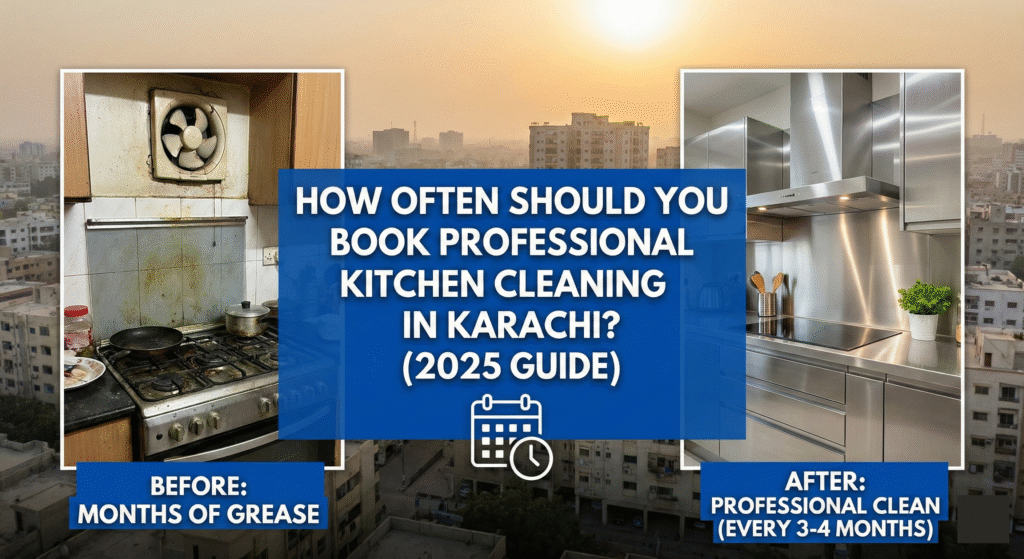
Kitchen deep cleaning in PECHS Karachi sits at a different intersection than the rest of our route. PECHS is denser in apartments than DHA, older in construction than Bahria, and pulls a traditional desi cooking profile heavier in ghee, mustard oil and tarka than Clifton. Block 6 mid-rises run shared ventilation shafts that cross-contaminate biofilm between neighbouring kitchens; Blocks 1-3 still hold their 1970s-90s bungalows with ceiling-mount exhaust fans instead of rangehoods; the Tariq Road frontage adds restaurant exhaust drift and traffic carbon. Add hard mains at 250-350 ppm CaCO3, and the protocol that works on a Phase 5 villa needs adjustment for a Block 6 flat or a Block 3 bungalow. From our DHA Phase 4 office we reach any PECHS address in 15-25 minutes. This page explains how, and how it differs from generic professional kitchen deep cleaning in Karachi.
Kitchen types we handle in PECHS — and what each one needs
A PECHS walk-through usually shows one of four kitchen types, each running a different protocol. Across all four, the kitchen hood, its baffles and filters, and the exhaust duct or shaft are outside our scope; we clean the kitchen around them.
Block 6 high-rise apartment kitchen. Smaller footprint (60-100 sq ft), open-plan onto dining, venting into a shared building shaft. The small footprint concentrates the grease load per square foot on backsplash, cabinet faces and counters. Access needs an HOA gate-pass and a weekday morning window.
Blocks 1-3 traditional bungalow kitchen. Larger footprint (120-180 sq ft), separated room layout, original 1970s-90s construction with ceiling-mount exhaust fans rather than rangehoods on most units. No rangehood means cooking grease drifts further — cabinet tops, ventilator grilles and the wall above the cooktop carry a heavier polymerised FOG load. Bungalows tolerate a longer working day (4-6 hours). Original parquet or mosaic floors near the cooktop need pH 6-8 neutral protocol — alkaline degreaser etches lime-mortar grout.
Shared-shaft mid-rise cluster (Block 6, parts of Block 2). 1990s-2000s 4-6 storey buildings where every unit vents into the same vertical shaft, so cooking aerosol and moisture from neighbouring kitchens drift back down the line. The shaft is a building-management matter, not ours; we clean inside the flat and leave a written note for the manager when we see signs of cross-contamination from above.
Tariq Road commercial-frontage flat. Residential units above commercial premises, or first-row lanes backing onto restaurants. Restaurant exhaust drift loads the cooktop side continuously; traffic carbon adds a fine grey film to cabinet tops. Maintenance interval lands closer to 4 months versus 6.
Why PECHS kitchens accumulate FOG faster than other neighbourhoods
Fat, oil and grease (FOG) accumulation on tile and cabinet faces follows a kinetic curve set by cooking style, ventilation and ambient dust. Three PECHS-specific factors push that curve steeper than DHA or Bahria.
Traditional desi cooking profile. PECHS households lean heavier on ghee, mustard oil and tarka — flash-frying whole spices at smoke point, daig cooking for family dawats, biryani releasing saffron-stained oil into the kitchen air for 45 minutes at a stretch. Triglyceride load per cooking hour runs measurably higher than a Bahria new-build kitchen on a Western mix. Fresh airborne FOG is soft and water-emulsifiable for 3-6 months, but Karachi heat and oxygen polymerise the triglycerides into a varnish-like carbon film that no longer responds to mid-pH cleaner. By month 6-9 most PECHS backsplashes carry a polymerised layer that needs pH 11-13 saponification — sodium hydroxide or potassium hydroxide hydrolysing the ester bonds back into water-soluble soap salts.
Apartment shaft cross-contamination. In Block 6 mid-rises and the shared-shaft cluster of Block 2, the shaft feeds cooking aerosol and moisture back from heavier-cooking neighbours, so a flat that cooks light still carries a moderate load on its own walls and cabinets. Mould signature is consistent — Aspergillus and Cladosporium. Quat at 200 ppm (BTC or DDAC) handles bacterial biofilm on kitchen surfaces; mould pockets need sodium hypochlorite 100 ppm with longer dwell.
Tariq Road dust pressure. Traffic carbon and silica fines drift onto cabinet tops, ventilator grilles and upper backsplash on first-row addresses. The dust binds to airborne oil mist into a sticky grey-brown film needing the same alkaline-plus-surfactant combo as polymerised FOG.
Our PECHS kitchen deep cleaning protocol — 6 steps
Every PECHS job runs through the same six-step protocol. Chemistry changes by surface and grease load; discipline does not.
Step 1 — Pre-survey + fire-safety code check. Supervisor walks the kitchen. Apartments: note where the kitchen vents (some 1990s Block 6 conversions illegally vent into window cavities — fire-code issue we flag to the building manager). Bungalows: locate acid-sensitive surfaces (parquet, mosaic, brass). Visual grease-load rating on backsplash and cabinet faces (fresh / oxidised / polymerised). 15 minutes.
Step 2 — Vacuum + disassembly. HEPA wet-dry vacuum on cabinet tops, ventilator grilles, behind appliances, floor-wall joints near the cooktop — these hold the grease-dust matrix that turns into slurry the moment liquid touches it. Burner caps and grates come out into the heated alkaline soak tank (60-70°C, pH 12-13).
Step 3 — Pre-treatment dwell on cured FOG. Alkaline degreaser at pH 11-13 (NaOH or KOH base) by foam sprayer to backsplash tile, the wall above the cooktop and upper cabinet faces. 8-12 minute dwell on fresh oxidised FOG; 15-20 minutes on polymerised layers. Saponification visibly bubbles. Wood cabinet faces step down to pH 9-10 anionic SLS surfactant. Granite or marble counters step down to pH 6-8 neutral with EDTA or sodium citrate chelator — strong alkaline etches polish irreversibly.
Step 4 — Main clean: HWE at 60-70°C plus manual scrub. Hot-water extraction at 60-70°C on tile and grout — above the triglyceride melt range of 35-45°C so cured FOG emulsifies into the rinse rather than smearing. EDTA chelator in the tank water sequesters PECHS hard-mains hardness ions (250-350 ppm CaCO3) so the surfactant works at full power. Manual scrub on burner caps and grates with brass and nylon brushes (never steel on stainless or brass orifices). Second-pass neutral-pH rinse flushes remaining alkaline.
Step 5 — Sanitise (quat 200 ppm or NaOCl 100 ppm by surface). Food-contact surfaces — counter, sink, cabinet interior, fridge and microwave handles — get quaternary ammonium at 200 ppm (BTC or DDAC), 5-minute dwell, no rinse. Quat penetrates biofilm better than hypochlorite. Kitchen walls with visible mould get NaOCl 100 ppm with 10-minute dwell — better than quat on Aspergillus and Cladosporium. Cutting and prep area finishes with peroxyacetic acid (rinse-optional).
Step 6 — Speed-dry and leave-in barrier. Air movers cut dry time from 4-6 hours passive to 2-3 hours active. AC at 22-24°C dehumidifies. Optional fluorocarbon barrier on grout (beads grease 6-9 months) and food-grade mineral-oil polish on stainless. Burners lit and tap flow checked at handover.
Apartment vs bungalow — different jobs
Smaller kitchens carry higher grease density per square foot — a Block 6 60-sq-ft kitchen running daily desi cooking loads its backsplash as heavily as a 150-sq-ft Block 3 bungalow on the same calendar.
Apartments (Block 6, parts of Block 2). HOA gate-pass arranged ahead — managers typically need 24 hours’ notice. Weekday morning windows only; no evening, weekend or Friday prayer-time access. Lift access for the alkaline tank and steam unit needs pre-coordination (some 1990s lifts won’t take the full kit; we walk it up service stairs). Shared shaft means we flag upstream cross-contamination — building-wide treatment is the only durable fix. Typical visit 2-3 hours.
Bungalows (Blocks 1-3, parts of Block 5). Direct owner access. Original construction means more acid-sensitive surfaces — mosaic tile, parquet, brass handles. Ceiling-mount exhaust fans rather than rangehoods on most units, so the cabinet tops and the wall above the cooktop carry more of the load. Typical visit 4-6 hours.
A real PECHS case — what the work actually looks like
PECHS Block 3 bungalow, 1985 construction, ceiling-mount fan, mosaic floor. Single-storey off Khalid bin Walid Road, family of five, three years since last deep clean. Original ceiling-mount fan above the cooktop had collected a thick varnish-like polymerised FOG layer on blades and housing. Cabinet tops carried the grease-dust matrix typical of ceiling-fan kitchens — fan throws mist sideways rather than capturing upward, so adjacent cabinets load faster. Five-hour protocol: fan dismount and 45-minute alkaline tank soak at 70°C, cooktop wall and cabinet-top pH 12 dwell, HWE 65°C on tile face, pH 6-8 neutral with EDTA on mosaic lines (lime-mortar grout would have etched under stronger alkaline). Quat 200 ppm on food-contact surfaces. Brass fittings descaled with citric 10%. Booked on a 6-month cycle.
Pricing in PECHS — what affects the band
Priced by kitchen size, kitchen type (apartment vs bungalow), and sanitisation scope. No PECHS postcode premium — identical published bands to DHA, Clifton, Bahria.
Small Block 6 apartment kitchen (60-90 sq ft, single cook zone): PKR 6,000-9,000.
Standard PECHS apartment kitchen (90-120 sq ft, granite counters): PKR 8,000-12,000.
Larger bungalow kitchen Blocks 1-3 (120-180 sq ft, ceiling-fan or rangehood, original tile): PKR 12,000-18,000.
Post-renovation deep clean (paint splash, cement haze, sealer off-gas): PKR 16,000-26,000.
Add-ons: tariq-road dust-pressure extra vacuum pass PKR 1,500-2,500; fluorocarbon grout barrier PKR 2,000-3,500; quat sanitisation full surface PKR 1,500-2,500. Bundles with full house deep cleaning or sofa cleaning get 10-15% off. Final price confirmed by the supervisor on-site after pre-survey.
How to book and what to expect
Fastest channel is WhatsApp to +92-311-1101810. Send a 30-second video walkthrough — cooktop and backsplash, sink, counter material, floor — plus block number and apartment vs bungalow. We confirm price band and slot within 30 minutes during business hours (Mon-Sat 09:30-20:00). Same-day for PECHS is the norm — our DHA Phase 4 office is 15-25 minutes away depending on traffic and block (PECHS is actually closer than most of DHA Phase 7-8).
A three-person crew arrives with high-temperature steam generator (4-6 bar, 120°C), heated alkaline soak tank (30L), foam sprayers, HEPA wet-dry vacuum, colour-coded microfibre, pH meter, brass and nylon brushes, EDTA chelator, NaOCl for mould pockets, quat sanitiser, air movers and floor tarps. Time on floor: 2-3 hours for a Block 6 apartment, 4-6 hours for a Blocks 1-3 bungalow, 6-8 hours for a post-renovation clean. Plan to be out of the kitchen during the working hours. Block 6 access needs the building manager’s gate-pass 24 hours ahead; send the building name when you book and we email the request directly. Every job is backed by a 7-day touch-up.
PECHS-specific FAQ
Do you cover all PECHS blocks including Block 6 high-rises?
Yes. PECHS Block 1 through Block 6, the Tariq Road corridor, and boundary lanes into KDA-1 and Bahadurabad at identical published rates. Block 1-3 bungalows are 20-25 minutes via Shahrah-e-Faisal; Block 6 mid-rises are 15-20 minutes via Shahrah-e-Quaideen. Same-day during business hours for any block. Same crew as our pest control in PECHS Karachi route — kitchen-plus-cockroach combos coordinate easily.
How do you handle apartment kitchen access in PECHS?
Send the building name when you book; we email a gate-pass request to the manager 24 hours ahead. Weekday morning windows only — no evening, weekend or Friday afternoon disruption. Lift access for the alkaline tank and steam unit is pre-coordinated. We carry the treatment record and public-liability docs most PECHS managers require.
Do you clean the kitchen hood or the shared exhaust shaft?
No. The kitchen hood, its baffles and filters, and the building’s shared exhaust shaft are outside our scope. We clean the kitchen around them — backsplash, cabinet faces, counters, sink, floor and food-contact surfaces. Where a recurring smell or mould looks like it is coming from the shared shaft, we flag it in writing so the manager can arrange a building-wide fix.
Do you require HOA approval for PECHS apartment cleaning?
Not approval, but coordination. Block 6 and Block 2 mid-rise managers typically need 24 hours’ gate-pass notice. We email the manager with technician names, vehicle registration, ETA and standard public-liability docs. The homeowner remains the decision-maker. For older flats outside formal HOA structures, chowkidar gate-pass is sufficient.
How does Tariq Road dust pressure affect cleaning schedules?
Restaurant exhaust drift and traffic carbon settle on cabinet tops, ventilator grilles and upper backsplash on first-row addresses every dry day. The film needs the same alkaline-plus-surfactant combo as polymerised FOG. Practical effect: maintenance interval lands closer to 4 months for first-row, 6 months for inner blocks. We recommend a quarterly cabinet-top wipe-down between deep cleans.
What’s same-day versus scheduled service from your DHA Phase 4 office to PECHS?
PECHS is closer to our Phase 4 office than DHA Phase 7-8 — 15-25 minutes by block. Same-day during business hours (Mon-Sat 09:30-20:00) is the norm. Block 6 apartments needing HOA gate-pass typically schedule next-business-day for 24 hours’ manager notice. Bungalows with direct owner access run same-day reliably. WhatsApp +92-311-1101810 with a video walkthrough is the fastest path to a confirmed slot.
Can you do post-monsoon mould treatment in PECHS bungalows?
Yes — common October-November booking. Blocks 1-3 bungalows with no modern damp-proof course pull monsoon humidity into kitchen walls, and grease-laden surfaces above the cooktop develop Aspergillus and Cladosporium pockets through September-October. Durable kill needs NaOCl 100 ppm with 10-minute dwell on identified mould zones, followed by speed-dry to break the humidity cycle. We flag underlying plumbing or ventilator failures — the cleaning is a reset, not a structural fix.
Do PECHS apartments get cockroach pressure that’s connected to kitchen grease?
Yes — strongly. Apartment kitchens with polymerised FOG in cabinet voids sustain a German cockroach (Blattella germanica) population surface spraying cannot clear, because the grease itself is the food source. The deep clean strips the food substrate; pairing it with an indoxacarb gel-bait treatment via our cockroach treatment service on the same visit is the durable fix.
Book kitchen deep cleaning across PECHS Block 1-6 and Tariq Road
WhatsApp or call +92-311-1101810, email contact@nestfumigationservices.com. Same-day across PECHS Blocks 1-6 and the Tariq Road corridor from our office at Plot #14, 2/1 2nd Gizri Street, DHA Phase 4, Karachi 75500, Mon-Sat 09:30-20:00. ISO 9001:2015 certified; members of KCCI, SPMA and PPMA. The same team runs our pest control in PECHS Karachi route — kitchen cleaning plus cockroach treatment, or full-house bundles, coordinate easily on one visit. For wider context see professional kitchen deep cleaning in Karachi.

Saad Danish is a co-founder and director of Nest Fumigation Services Private Limited, a licensed pest-control and fumigation company based in DHA Phase 4, Karachi. He oversees the company's administration, client services, and marketing, working alongside NFS's technical team to deliver residential and commercial pest management across Karachi — from termite proofing and general pest control to HACCP and Sindh Food Authority compliance programmes for food, warehouse, and industrial clients. Nest Fumigation Services is ISO 9001:2015 certified and a member of the SPMA (Sindh Pest Management Association), PPMA, and the Karachi Chamber of Commerce and Industry.
More about our team →