







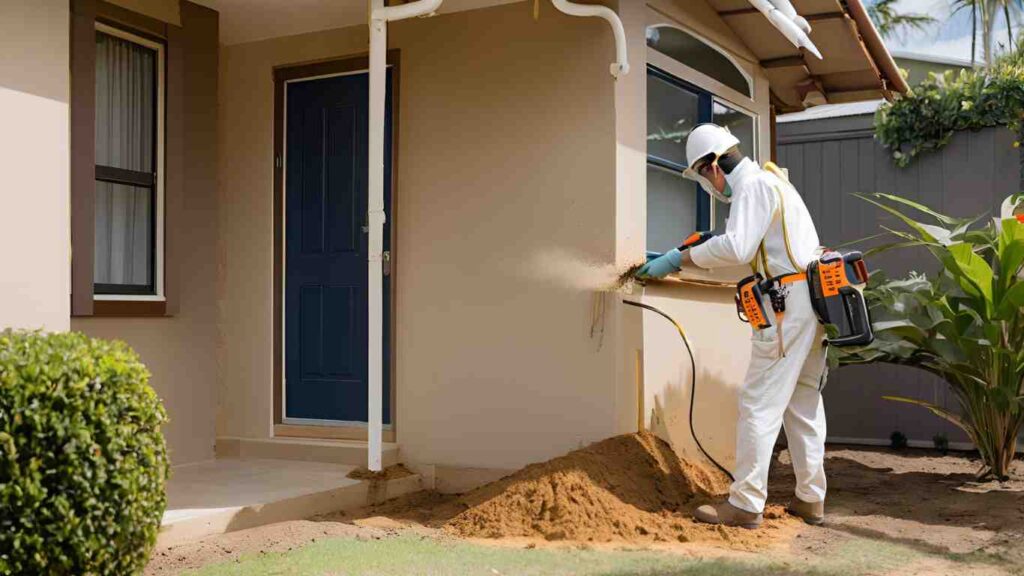
Clifton is not one termite problem — it is at least three. We work out of our DHA Phase 4 office, about a 15-minute drive across the bridge into Block 4, and the pattern across our site visits is consistent. Blocks 1 through 5 carry the city's second-heaviest Coptotermes heimi pressure after old DHA — 1970s and 1980s bungalows, mature gardens, original wooden doorframes, decades of established colony networks. Blocks 6 through 9 flip the profile: post-2000 mid-rise apartment stock, serviced units along the Khayaban-e-Shahbaz extension, lighter termite load but heavier mosquito and rodent pressure. Boat Basin sits on the commercial-residential edge where restaurant kitchens and ground-floor retail change the pest mix. Along the Sea View corridor, reclaimed coastal soil forces a different volume and trenching decision than the inland blocks. This page lays out our block-by-block termite control services Karachi protocol for Clifton — chemistry, application method, IS 6313 compliance, and the warranty we put in writing — seven years with standard fipronil, ten with the Agenda upgrade. For the broader picture across all pest verticals see the Clifton pest control overview.
Why Clifton Termite Pressure Varies By Block
Clifton was developed in roughly four waves between the 1960s and the 2010s, and the termite ecology tracks the construction history block by block. A protocol that works in Block 2 is the wrong protocol for a serviced apartment tower in Block 8.
Clifton Block 1-5 — The Heritage Bungalow Belt
The 1970s and 1980s bungalows of Blocks 1 through 5 are where Coptotermes heimi is heaviest in Clifton. Lath-and-plaster walls in the oldest stock, original wooden doorframes, mature gardens with 30-50 year old neem, gulmohar, and ficus root mass feeding soil moisture. Mud-tube damage on plinth walls and doorframes is the signature finding. Colonies are often decades old and run across multiple plots through shared compound walls — we have treated three adjoining Block 4 bungalows in the same week because one colony was foraging across all three. We average three to four termite jobs a month across Block 1-5, higher in the post-monsoon window.
Clifton Block 6-9 — Mid-Rise Apartments + Serviced Units
The newer mid-rise stock from Block 6 into 7, 8, and 9 carries meaningfully less foundation-level termite pressure: concrete-and-slab construction, less untreated wood, younger landscaping, deeper pile foundations on some towers. Where we do see termite here it is usually on the lower floors via plumbing penetrations and basement parking ramps, or on ground-floor retail. Dominant pest pressure is mosquito, rodent, and occasional bed bug calls on serviced apartments. Termite is the minority job here, with apartment-by-apartment treatment logic different from a freestanding bungalow.
Boat Basin — Commercial-Residential Edge
Boat Basin is the commercial spine running through Clifton: restaurants, salons, retail, and clinics on the ground floor with residential above. The termite profile here is unusual — kitchen cabinet bases, wooden cladding behind restaurant interiors, and stored paper in storerooms attract Heterotermes indicola in particular. We run termite work here in coordination with all pest control services bundles because the same site usually needs cockroach gel-bait and rodent stations on the same visit.
Khayaban-e-Bukhari + Khayaban-e-Shahbaz Corridor
The two commercial corridors host offices, clinics, F&B, and ground-floor retail in late-1990s to mid-2010s concrete construction. Upper-floor termite pressure is low; work concentrates on ground-floor storage, plinth zones where landscaped planters meet the structure, and around utility entry points. Cadence is typically annual maintenance contract.
Sea View + Reclaimed Coastal Edge
Blocks closest to Sea View sit on reclaimed land or heavy marine-clay soil. Heavy coastal clay moves groundwater through the profile differently from the inland blocks, so we raise working-solution volume and tighten the perimeter trench rather than change the active. The chemistry is standard fipronil either way; the volume call is made at the site after a soil-feel test.
Coptotermes heimi — Why It Is the Clifton Heavy Hitter
Coptotermes heimi is subterranean — it lives in soil and travels into the structure through mud tubes built up plinth walls, expansion joints, and plumbing penetrations. It targets cellulose: doorframes, skirting, kitchen cabinet bases, parquet flooring, paper-backed gypsum board.
Visible signs we look for during a Clifton inspection: 3-5mm mud tubes running up plinth wall bases (especially on the garden side of Block 1-5 compound walls), fine sand-grain frass near doorframes, a hollow tap-tone on skirting that should sound solid, blistered paint at door bases, and during the swarming windows (March-April and post-monsoon September-October) discarded wings near windows. The termite signs reference walks through field identification in detail.
Why this species matters more than the others: colony size. A mature Coptotermes heimi colony runs 10,000 to 100,000 individuals — the largest of the three termite species we see commonly in Karachi. Heterotermes indicola runs alongside it on roughly a third of our Block 1-5 jobs, focused on compound walls, stored paper, and plywood furniture. Microcerotermes species show up less often as carton-nest galleries on garden trees — cosmetic more than structural. When a full-size Coptotermes heimi colony establishes, damage compounds quickly: kitchen cabinet bases inside 18 months, doorframe failure in 3-5 years, parquet buckling in 5-7. Catching it at the mud-tube stage versus the failed-doorframe stage is the difference between a 30,000 PKR treatment and a 400,000 PKR carpentry rebuild.
How We Treat — Standard Fipronil Drill-and-Inject Grid
Our standard Clifton post-construction protocol is the IS 6313 six-stage drill-and-inject grid — the Indian Standard specification for post-construction termite barriers, layered with ISO 9001:2015 process documentation.
Stage 1: Inspection (45-60 minutes)
Plinth wall walkdown around the full footprint, doorframe tap-test on every room, kitchen cabinet base check, attic and roof slab inspection where accessible, compound wall and garden tree survey. We GPS-tag every active mud-tube location. Output is a marked floor plan with treatment zones and chemistry volume that the homeowner signs before we mix.
Stage 2: Mixing On Site
Standard fipronil concentrate is mixed in front of the homeowner at the label rate — no pre-dilution off-site. A typical 500 sq.yd (1 kanal) Block 4 bungalow needs roughly 360 litres of working solution. The homeowner watches the factory seal break on site. Sea View edge plots take more volume per metre; the active does not change.
Stage 3: Drill-and-Inject Grid Application
12mm holes drilled at 30cm spacing along the affected plinth wall base, around plumbing penetrations, and at expansion joints. Working solution injected at 5 L/m² of soil-concrete interface and 7.5 L/m² at external perimeter trenches. Holes sealed with white cement matched to the existing finish — Clifton homeowners are particular about visible patching on tiled and marble plinths.
Stage 4: Documentation
ISO 9001:2015 logbook entry the same day — date, technician name, chemistry batch number, total volume, drill point count, GPS-tagged zones, before-and-after photos. Retained seven years. Homeowner gets a stamped copy and a digital PDF.
Stage 5: Day-30 and Day-90 Follow-Up
Re-inspection at 30 and 90 days. We look for new mud tubes in untreated zones, recheck the active zones we treated, and re-treat any new activity under warranty at no charge. Built into the base price, not an upsell.
Stage 6: Written Warranty
Written warranty covering re-infestation of the treated structure. Termite proofing — pre-construction soil treatment, or a full drill-and-inject barrier on an existing building — carries seven years with standard fipronil, or ten years with the Agenda upgrade (quoted on request). Termite control — treating an active zone without a full barrier — carries one year, with no AMC extension. Proofing warranties are transferable on property sale — useful in Clifton where bungalow turnover is high and serviced apartments change ownership often.
Why Not Pyrethroid
Cypermethrin, Deltamethrin, Bifenthrin — the synthetic pyrethroid family — are repellent chemistry. Termites detect treated soil and tunnel around it, splitting the colony into satellite harborages. The homeowner sees no termite for 6-12 months and then finds fresh mud tubes in three new locations. Fipronil is non-repellent — termites walk through the treated zone, pick up the active ingredient on cuticle contact, and transfer it through grooming and trophallaxis (mouth-to-mouth food sharing) back to the colony. The colony collapses over 7-21 days. We see pyrethroid-treated foundation work come back as failed-job cleanups regularly in Block 1-5 — one of the most common reasons a Clifton homeowner calls us for a second opinion. Coptotermes heimi in particular tunnels around pyrethroid barriers under field conditions.
Clifton Chemistry Decision Matrix
| Block / zone | Soil profile | Property type | Recommended chemistry |
|---|---|---|---|
| Block 1-5 bungalows | Mixed inland | Residential | Standard fipronil |
| Block 6-9 mid-rise apartments | Mixed | Residential apartment | Standard fipronil (plinth + ground-floor units) |
| Boat Basin commercial-residential | Mixed | Mixed-use | Standard fipronil + above-ground spot work |
| Khayaban-e-Bukhari corridor | Mixed | Commercial / office | Standard fipronil, plinth barrier |
| Khayaban-e-Shahbaz corridor | Mixed | Commercial / serviced apartments | Standard fipronil, plinth barrier |
| Sea View edge plots | Coastal clay / reclaimed | Residential | Standard fipronil, higher volume |
| Pre-construction new build | Per-site soil test | All | Standard fipronil, or Agenda for the 10-year upgrade |
Clifton Pricing
| Plot footprint | Chemistry volume | Indicative range (PKR) |
|---|---|---|
| 240 sq.yd (10 marla, Block 6-9 unit) | ~180 L working solution | 18,000 – 28,000 |
| 500 sq.yd (1 kanal, Block 2-5 bungalow) | ~360 L | 32,000 – 48,000 |
| 1,000 sq.yd (2 kanal, Block 1-4 large bungalow) | ~700 L | 58,000 – 88,000 |
| Apartment unit (ground floor, Block 7-9) | ~80-120 L | 14,000 – 22,000 |
| Boat Basin commercial ground-floor unit | ~100-180 L | 22,000 – 38,000 |
| Pre-construction (new build) | ~150-280 L | 48,000 – 165,000 |
Rates include inspection, on-site mixing and grid application, IS 6313 six-stage sign-off, day-30 and day-90 follow-up, and the written warranty: 7 years on termite proofing with standard fipronil (10 years with the Agenda upgrade, quoted on request), 1 year on spot termite control. Full breakdown on the termite treatment cost page and broader pest control prices reference.
Frequently Asked Questions
How fast can you reach Clifton from your DHA Phase 4 office?+
Same-day inspection. Typical reach time is 15-25 minutes for Block 1-5 across the bridge, 20-30 minutes for Block 6-9 and the Khayaban-e-Shahbaz corridor depending on Sunset Boulevard traffic. Boat Basin sits roughly 15 minutes out.
Is the termite treatment safe around children and pets in a Clifton bungalow?+
Used the way we apply it, yes. The fipronil is injected into the soil-concrete interface and sealed under the plinth wall finish — no surface exposure inside the house. Keep children and pets off the drill points until the plugs are dry; the structure is safe to re-occupy the same day.
My Sea View edge plot was treated with Cypermethrin two years ago and termites are back. What happened?+
Pyrethroid foundation work fails in this exact pattern. The termites detected the repellent barrier, tunneled around it, and split the colony into satellite harborages outside the treated zone. Fresh mud tubes typically reappear at 12-18 months. The fix is a full standard-fipronil re-treatment of the foundation zone at the higher volume Sea View clay needs — the previous pyrethroid does not interfere with the non-repellent chemistry.
What is the warranty exactly?+
Termite proofing — pre-construction soil treatment or a full drill-and-inject barrier — carries a 7-year written warranty with standard fipronil, or 10 years with the Agenda upgrade. Spot termite control carries 1 year, not extendable on an AMC. Re-infestation of the treated structure inside the warranty period means we re-treat the affected zone at no charge. Proofing warranties are transferable on property sale.
What if my Block 4 bungalow already has visible doorframe damage?+
The chemistry treatment stops the colony and protects against re-infestation. Existing structural damage is separate carpentry or civil work — we do not do that in-house but we coordinate referral to carpenters we have worked with in Clifton and DHA for years.
Do you do annual maintenance contracts for Clifton apartments?+
Yes. Block 6-9 apartments and the Khayaban-e-Bukhari and Khayaban-e-Shahbaz commercial corridors typically run on quarterly inspection contracts. Block 1-5 older bungalows we recommend monthly inspection during the swarming windows and quarterly otherwise. Annual contracts carry a 15-20% discount versus per-visit work.
Can termite from my neighbour's plot enter mine through the shared boundary wall?+
Yes — one of the most common patterns we see in Block 2, 3, and 4. Coptotermes heimi forages across plots through soil and shared compound walls. If a neighbour has untreated active termite and you have not done a barrier, your plot is exposed. The drill-and-inject grid at your shared plinth + boundary wall blocks this entry route.
Get Termite Treatment in Clifton Karachi
If you are ready to schedule a site inspection across Clifton Block 1-9, Boat Basin, the Khayaban corridors, or the Sea View edge, we are 15-25 minutes away. Saad Danish, our founder, personally oversees the chemistry call on Sea View edge plots, large Block 1-5 bungalows, and any pre-construction job — the soil decision on your property is made by the founder on site, not a call-centre script.
Nest Fumigation Services Private Limited — ISO 9001:2015 process-certified, SPMA and PPMA member, KCCI registered. 175 verified Google reviews. Plot #14, 2/1 2nd Gizri Street, DHA Phase 4, Karachi. Mon-Sat 9:30am-8pm, Sunday closed.

Saad Danish is a co-founder and director of Nest Fumigation Services Private Limited, a licensed pest-control and fumigation company based in DHA Phase 4, Karachi. He oversees the company's administration, client services, and marketing, working alongside NFS's technical team to deliver residential and commercial pest management across Karachi — from termite proofing and general pest control to HACCP and Sindh Food Authority compliance programmes for food, warehouse, and industrial clients. Nest Fumigation Services is ISO 9001:2015 certified and a member of the SPMA (Sindh Pest Management Association), PPMA, and the Karachi Chamber of Commerce and Industry.
More about our team →