





Almost everything written online about "the most common pests in Karachi" is guesswork — generic lists copied from one blog to the next, none of it backed by a single real number. We decided to do the opposite. This page is built from our own service records: more than a thousand real pest-control jobs we completed across Karachi over 2025 and 2026. No estimates, no borrowed statistics — just what our books actually show, as shares of our total workload, aggregated and anonymised.
We're Nest Fumigation Services Private Limited, a licensed Karachi pest-control company based in DHA Phase 4. We think being open with our own operating data is more useful to a homeowner or facilities manager than another recycled listicle — and it's something no competitor in this city publishes. First, the honest caveats, because they're the point.
How to read these numbers (the honest part)
- This is our job book, not a city-wide health survey. The figures reflect our customers — which skew toward DHA, Clifton, and the commercial and residential clients we serve — not an objective census of every pest in Karachi. A neighbourhood being low on our list often just means we do less work there, not that it has fewer pests.
- Pest counts are "jobs that name the pest." Many visits are logged simply as general pest control (GPC) or by service booked, so the specific-pest numbers undercount. Termite, which people book as a distinct service, is logged cleanly; cockroach and ant work usually sits inside GPC, so those specific tallies read low.
- We're not claiming a "peak season" from this dataset. Our older historical records are less complete than recent ones, and booking volume rose as the company grew — either factor would confound a seasonal read, so we don't make one.
- Everything is aggregated and anonymised. No client, address, or individual is identifiable in anything below.
With that said, here's what our job book tells us.
What Karachi actually calls a pest-control company about
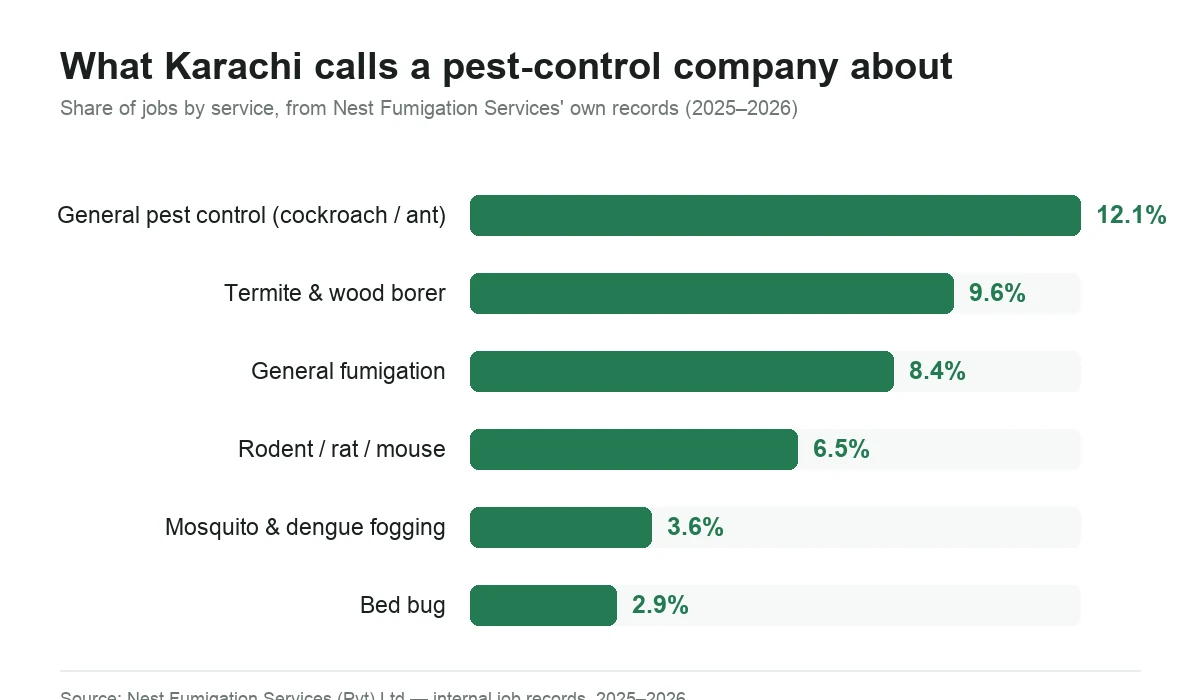
Ranked by how often the pest or service is named in the job record, as a share of our total workload:
| Service / pest | Share of jobs |
|---|---|
| General pest control (GPC — mixed cockroach/ant/crawling) | 12.1% |
| Termite & wood borer | 9.6% |
| General fumigation | 8.4% |
| Rodent / rat / mouse | 6.5% |
| Mosquito / dengue fogging | 3.6% |
| Bed bug | 2.9% |
The headline is that general pest control, termite work, and fumigation are the backbone of demand — together they account for roughly a third of everything we do. Two things stand out to us as operators:
Termite is the single biggest named pest service. Nearly one job in ten is termite or wood-borer work. That tracks with the Karachi we see on the ground: coastal humidity keeps soil moisture high, and the city's timber-heavy homes — doorframes, wardrobes, skirting — give Coptotermes heimi, our dominant subterranean termite, exactly what it forages toward. Termite damage is quiet and structural, which is why people book it as a deliberate, standalone job rather than a panic call.
Cockroach work hides inside "GPC." On paper cockroaches look rare in the table — but that's a logging artefact. In practice the German cockroach (Blattella germanica) is the pest most GPC visits are really about, especially in kitchens and food premises. When we break out what a "general pest control" visit actually treats, roaches and ants lead it.
Where we work across Karachi
Of the jobs where the neighbourhood is identifiable in our records, here's the distribution across the city:
| Area | Share of jobs |
|---|---|
| DHA (Defence) | 15.5% |
| Clifton | 10.2% |
| Korangi | 4.0% |
| Nazimabad / North Nazimabad | 2.7% |
| Gulistan-e-Jauhar | 2.4% |
| Gulshan-e-Iqbal | 1.8% |
| Malir | 1.6% |
| Bahria Town | 1.5% |
| PECHS | 1.5% |
| Saddar | 1.0% |
DHA and Clifton together are about a quarter of all our jobs. Part of that is simply where we're based — our office is in DHA Phase 4, so we're fastest and busiest across the Defence–Clifton belt. But it also mirrors the city: this is Karachi's densest strip of affluent housing plus restaurants, cafés, and offices, and that combination generates steady residential and commercial demand. The industrial and older-suburb clusters — Korangi, Nazimabad, Malir — show up strongly for rodent and factory work, which is year-round rather than seasonal.
What this means if you live or run a business in Karachi
A few practical takeaways we'd draw from our own numbers:
- If you own a home with wooden fittings, termite is not a rare event. It's our single most-booked named service. A one-off treatment plus a warranty, or pre-construction proofing if you're building, is the cheapest insurance against structural timber damage.
- "General pest control" almost always means cockroaches and ants. If a provider can't tell you which pest their GPC visit targets or which active it uses, that's a flag — see our published pest control prices for what an honest, itemised service looks like.
- Rodent and commercial work is continuous. The businesses in our books that stay pest-free are the ones on a recurring programme, not reactive call-outs.
Methodology
The figures on this page are drawn from our internal job-management records for more than a thousand completed pest-control visits across 2025 and 2026, expressed as shares of our total workload rather than raw counts. Pest and service categories were counted by matching the service logged on each job; a single visit can involve more than one pest, and visits logged only as "general pest control" are not attributed to a specific pest, so specific-pest shares are conservative. Neighbourhood shares are calculated over jobs with an identifiable area in the record. All data is aggregated; no customer is identifiable. We update this analysis as our records grow.
Frequently Asked Questions
What is the most common pest problem in Karachi?+
In our own job records, general pest control (predominantly cockroaches and ants) is the most frequent category, followed closely by termite and wood-borer work at nearly 10% of all jobs. Cockroaches appear lower as a named pest only because most cockroach work is logged as general pest control rather than by species.
Is termite really that common in Karachi homes?+
Yes. Termite and wood-borer treatment is the single most-booked named service in our records — close to one job in ten. Karachi's coastal humidity and timber-heavy homes make subterranean termite (Coptotermes heimi) a persistent structural risk, which is why homeowners book it deliberately rather than as an emergency.
Which areas of Karachi have the most pest activity?+
Our jobs concentrate in DHA and Clifton (about a quarter of all work), but that reflects our DHA Phase 4 base and the area's dense residential-plus-commercial mix rather than a claim that these areas objectively have more pests. Every Karachi neighbourhood has year-round pest pressure; the drivers differ by area.
Is this data a scientific survey of Karachi's pests?+
No, and we're clear about that. It is our own operational job record — real, but shaped by our customer base and how services are logged. We publish it because real data from an active operator is more useful than the copied, unsourced "statistics" found elsewhere, not because it is an epidemiological study.
How often do you update these numbers?+
We refresh this analysis as our digitised records grow. This edition draws on our 2025–2026 job data; future editions will extend the window and break the data down further as the dataset matures.
Talk to a Karachi Pest-Control Team That Keeps Real Records
Documented, data-driven pest control is simply better pest control — it is how you tell whether a treatment is working. If you want a provider that measures its work rather than guesses at it, that's us.
Nest Fumigation Services Private Limited — ISO 9001:2015 certified, members of SPMA, PPMA, and KCCI, rated 4.9 stars across 175 Google reviews. DHA Phase 4, Karachi.
Call or WhatsApp: +92-311-1101810 · Mon–Sat, 9:30 AM – 8:00 PM.

Saad Danish is a co-founder and director of Nest Fumigation Services Private Limited, a licensed pest-control and fumigation company based in DHA Phase 4, Karachi. He oversees the company's administration, client services, and marketing, working alongside NFS's technical team to deliver residential and commercial pest management across Karachi — from termite proofing and general pest control to HACCP and Sindh Food Authority compliance programmes for food, warehouse, and industrial clients. Nest Fumigation Services is ISO 9001:2015 certified and a member of the SPMA (Sindh Pest Management Association), PPMA, and the Karachi Chamber of Commerce and Industry.
More about our team →